Saturday, February 18, 2017

3 Beekman Place – The Art Direction/Set Decoration of Auntie Mame

31 Days of Oscar Blogathon
This post is an entry in the 31 Days of Oscar Blogathon hosted by Paula at Paula's Cinema Club, Aurora at Once Upon a Screen, and Kellee at Outspoken and Freckled.

In Auntie Mame, there are only about fifteen separate locales shown in the film. Most are relatively simple sets, shown only for a minute or two. A few others are fairly complicated, but from art and set design standpoint the real star of Auntie Mame is Mame's apartment at 3 Beekman Place, New York. The apartment is shown throughout the film and in most cases has a completely different decor each time it is shown. Further, all are fantastic. 

Auntie Mame received a total of 6 Oscar nominations including Best Picture, Best Actress (Rosalind Russell), Best Supporting Actress (Peggy Cass), and of course, our topic Best Art Direction-Set Decoration, Black-and-White or Color for Malcolm C. Bert, Art Direction, and George James Hopkins, Set Decoration. 

Auntie Mame was the second of two Academy Award nominations for Art Director Malcolm C. Bert. The other nomination was for A Star Is Born (1954). Malcolm Bert's other credits include East of Eden, Rebel without a Cause, The Pajama Game, and numerous TV shows, such as Gun Smoke, Bewitched, and The Monkees.


Set Decorator George James Hopkins was nominated for eleven Oscars in his long career.  He won four Academy Awards for A Streetcar Named Desire, My Fair Lady, Who's Afraid of Virginia Wolff?, and Hello, Dolly! His other credits include Casablanca, Mildred Pierce, Strangers on a Train, and The Great Race. In the silent era, he has credits as actor, writer, costume designer, and production manager, among others.

In the credits for Auntie Mame, Robert Hanley is listed as Consultant for Interior Design. I assume this type of credit was rare at the time, but considering how spectacular the interiors of 3 Beekman Place are, presumably some of the credit should go to Hanley as well. 

As I was writing this, I came to realize that the sets in Auntie Mame all serve a certain function. Obviously, 3 Beekman Place is an extension of Mame's vibrant personality, showing her enjoying life's banquet, while the rest of the world starves to death. The apartment is almost another character in the film, a character much more interesting than many of the living breathing people in the film. 

Let's start with the other locales and see how they work. All can be put into a number of different categories:
  • Places Mame works – Early in the film, in fact only weeks after Patrick arrives, the stock market crash of 1929 occurs, wiping out Mame financially, forcing her to get a job. From these scenes, you learn something about Mame. First, in a very funny way, you learn how hopelessly ill-prepared she is to support herself, but more importantly, you learn how much how much she loves Patrick and that she is willing to do anything for him. Mame's jobs include, a small role in Vera's play Midsummer Madness, telephone operator at Widdicombe, Gutterman, Applewhite, Bibberman, and Black, and saleswoman at Macy's toy department, where she meets her future husband Beau (Forrest Tucker).
Widdicombe, Gutterman, Applewhite, Bibberman,
and Black
[You can click on images to enlarge; in some cases, they may seem blurry, especially if camera or actors were moving, probably, a reflection of way I did screen captures]
  • Patrick's schools – These places show one thing, Mr. Babcock's efforts to make Patrick as unlike Mame as possible. Fortunately, it doesn't take. The first of these is the Bixby School, where Mr. Babcock wants Patrick to go. Patrick doesn't attend school there, but rather Mame sends him to a progressive school in Greenwich Village where the children play fish family. Afterwards, Mr. Babcock insists that Patrick attend a boarding school, St. Boniface. Later, a grownup Patrick attends Rumson University also at Mr. Babcock's behest, but at Rumson, Mame is constantly sending Patrick souvenirs from her exotic travels.

St. Boniface
  • Places Mame goes – After marrying Beau (Forrest Tucker), they travel to Egypt on their honeymoon. You also see that Auntie Mame and Uncle Beau take young Patrick to Paris. Presumably, this was one of many trips they took Patrick on while he was growing up. The last of these is the Matterhorn, where Beau falls off the mountain. None of these sets are particularly extravagant. To be honest, the Matterhorn looks a lot like the ride at Disneyland to me. 
Yodel le he hooooooooo!!!
Finally, we see two other homes. Honestly, I think this is to show how normal people live in comparison with Mame, but really we are talking about how other upper-class people compare.

  • Peckwood – This is Beauregard Jackson Pickett Burnside's family plantation. It is a very traditional Southern mansion. You could film a historical drama about the old South there. Reflected is old money, and the pursuits of the gentry of a bygone era, horses and fox hunts. The name of the plantation, Peckerwood, is the traditional name of plantation.
Peckerwood
  • Upson Downs – This is the estate of grownup Patrick's fiancee's parents. Often they mention that it is a restricted community, and Mr. Upson wants to buy the property next door to prevent a world-reknown cellist from moving in because he is Jewish. You really only see the patio, but there are interesting details beyond the honey daiquiris, such as a spinning wheel and butter churn alongside the ceramic lawn gnomes. Obviously, this is new money, trying to impress people with valuable antiques placed out-of-doors. The self-dubbed name of Upson Down is a title they invented to try to usurp the tradition of the old money.
Upson Downs
3 Beekman Place

This is why we're here. Auntie Mame's apartment appears throughout the film, and often is used as a time marker in the film. There are six distinct decors. In addition, Auntie Mame uses the chandelier as transitional element from one decor of the apartment to the next.

First appearance – Oriental decor. This our introduction to Mame and 3 Beekman Place, when a frightened, newly orphaned Patrick shows up. The first view of the apartment is an elaborately carved Chinese dragon door with steam shooting out the nostrils and a gong that plays when you ring doorbell. Also the dragon eyes open into a peephole for the servant, Ito, to screen the party guests. The color palette is muted with cream walls, to highlight the Oriental art and statuary virtually everywhere. This is also one of the few times that you see more than a glancing view at the upstairs of the apartment.

Dragon door, Patrick's first impresion

Ito looks through peephole

Even piano is Asian inspired

First view of Mame and one of few
views of upstairs

Behind Mame is another interior dragon
 door and Chinese lion, lower right

Oriental screen separating dining room

Mame introduces Patrick to fish berry jam
(cavier), served from Buddha's belly

Great details here, Asian demon statue
behind Mame and Patrick, guests cooking
on open flame, and Vera with long handle
on Martini glass

Oriental details mostly obscured by party
guests, but what a view of Brooklyn Bridge

First lady of American theater being carried
to bed; note traditional banister

At foot of stairs, banister morphs into
dragon head

Sculpture room, where Mame's sculptor
friend had lived

Mame's bedroom suite

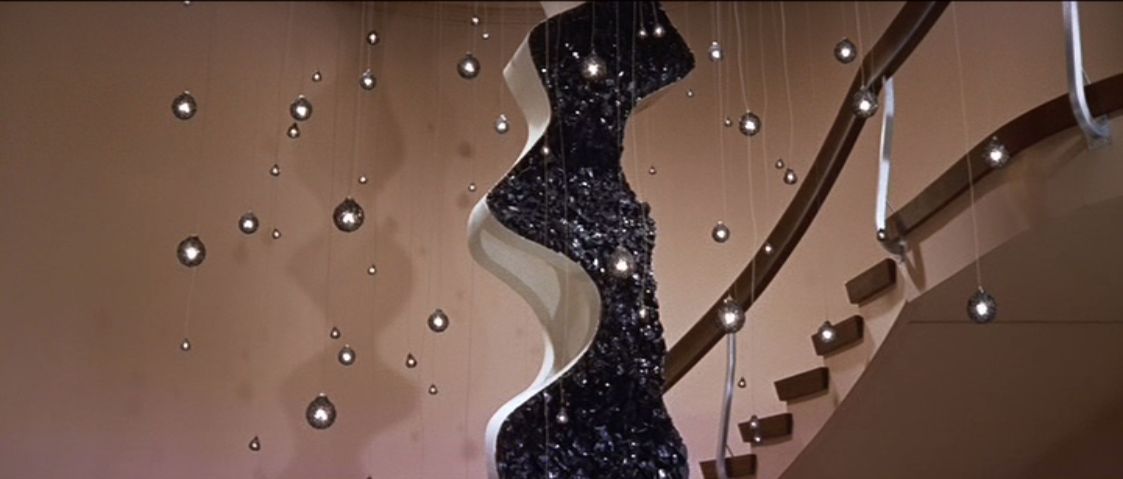
Oriental chandelier, dissolves into chandelier
for next incarnation of Beekman Place

Second appearance – Modern traditional decor. Bear in mind I know very little about design. Possibly, there is a name for this. I call it modern traditional. Modern fits. I added traditional most because it retains traditional elements like columns and urns. The color palette is blues, grays, and purples. We see it both before and after stock market crash. After the crash, you can see evidence of Mame's dire financial situation.


Modern chandelier 

Workmen hang new modern art; note
new banister on stairs

Mame's bedroom, completely new look
from last time we saw it

Marie Antoinette room, were Vera
routinely passes out

Entry foyer, note simplified columns/urns
and modern painting on right

Patrick mixes martinis, great bar cart and
modern art on right

Simple elegant furniture

Exterior hallway decorated to match

More modern art center above Patrick

And behind Mame here

After stock market crash, Patrick provides
his own art, signed Patrick Picasso, his
black and blue period

 More evidence of their dire financial
situation, wall (center) shows where art
formerly hung, now hocked; also bar
cart (right) now empty 

Third appearance – French provincial, I think. Mame returns to Beekman Place after Beau has died. The color palette is light taupe with black and gold accents. To me, this is the least interesting. Still, everything is elegant and tasteful, and you do see evidence of Mame's exotic nature with some of the accent pieces.  


Again we start with chandelier

Banister is same as last, but sash accents
have been added

Entry way, with decorative palm tree

Mame in mourning, note obelisk
behind Vera

French provincial desk and cherub
on terrace 

Elegant details abound, especially around
fireplace (left)

Fourth appearance – Library decor. At this point in the film, Mame is fully immersed in writing her memoir. Naturally, she has redecorated in a library motif. The artwork and sculpture has a Renaissance feel. This is where we meet Patrick's fiance, Gloria Upson, who comments on the decor, "Books are awfully decorative, don't you think?" That about sums her up.


Another chandelier, a little more ornate
than last

Bannister appears to be same as Oriental
one without the dragon
Spiral library ladder to get at those
awfully decorative books

New piece of furniture added, editor and
ghost writer, Brian O'Bannion

Miss Gooch, types up Mames manuscript;
note Shakespeare bust

The muse can take many forms, such as
the harp behind Mame

Grownup Patrick enters to Roman-inspired
busts either side of door

Author Mame takes break at
mahogany bar 

Fifth appearance – Danish modern decor. After being entertained by the Upsons, Mame redecorates to return the favor and welcome them to the family. This time it is the work of famed designer, Yul Oolu. Of all the incarnations, of 3 Beekman Place, this is my favorite, though I don't think I could live there without regular infusions of Flaming Mames.


New chandelier, well, sort of

Sculpture that can be used upside down

Simple modern banister and Mame
feeds the fish

That's right, fish

And outside the apartment, more fish

What Danish modern is complete without
kinetic sofa

Drinks all around, love centered doorknob
in background

And of course lotus nectar for Patrick's
former teacher

Mobile gets in Mr. Babcock's, umm, hair

He's not the only one with something in
his hair

Sixth and final appearance – Indian decor. It is now years later. Patrick has married Pegeen, a woman worthy of both him and Mame. They have a son, roughly the same age as Patrick was when he came to live with her. Mame has come full circle, though perhaps spiral is a better term, because each time around, you end up on a different level. Thus, 3 Beekman Place returns to the East, India this time.


What do you know, another chandelier

Stair banister same as previous but
updated to blend with Indian motif

Mame adorned in gold

Front entry foyer

Great relief behind Mame; fish have
been replaced by flowers

Mame leads her new protege up
the mountain


#####

Auntie Mame didn't win any Oscars. The Oscar for Art Direction-Set Decoration for 1959 went to Gigi. I honestly don't think I can complain about this. Art direction for Gigi was both innovative and first class with the design inspired by famous French art of the era. Perhaps on a different year, Auntie Mame might have fared better, but that doesn't take away the wonder that is 3 Beekman Place.

Thursday, February 16, 2017

Politics and the Fake News

Honestly, aside from the odd comment, I try to avoid politics. At least, once a day, I get dragged into it by my wife, when she asks if I saw something she posted on Facebook. I never have, because about 90% of what I see on Facebook is political. I get enough politics from the Fake News (The Daily Show). The Daily Show will be the first to admit they are Fake News. After The Daily Show, I go to sleep and probably have terrible dreams, but since I never remember my dreams, that's fine by me. I don't need more politics. I need more pictures of puppies. Hence, I avoid Facebook.

This morning I watched President Trump's press conference. Now, the president has been criticized for calling the media, Fake News, and I think I might be starting to agree with him, but for totally different reasons. The press conference went like this. The president said more or less the following. The world is screwed up. This country is screwed up. Honestly, I can't disagree with him. He said that despite the resignation of Michael Flynn, his administration is running like a well-oiled machine. Ohhhh-kayyy. He said the news was fake but leaks were real. He spoke about the Muslim ban and how the courts were not cooperating. He also said he beat Hillary. Dude, get over it. He said he won by the biggest electoral margin since Reagan. Finally, he mentioned some stuff about jobs. 

During the followup, about 90% of the questions were about either the Michael Flynn thing, and a connection between the Trump campaign and Russia, and what he meant by the news being fake and the leaks being real. On followup, to their credit, someone did point out that Trump did not win by the biggest electoral margin since Reagan. Trump explained that he meant as a Republican, and this was just the information someone had given him. Technically, even his correction to his statement was incorrect, George H.W. Bush won by a bigger electoral margin too.

I get it. The Russian thing is a big story and may turn out to be the smoking gun that brings down the president. Yes, I do understand most of the people in the White House press corps own the Special Edition Blu-Ray of All the President's Men, but guess what, you are not going to ask that one question that brings down the president as a followup. 

After the press conference, George Stephanopoulos complained about how out of touch the president was especially with regard, to the well-oiled machine comments. Now this is why I'm thinking Trump may be right about the media being Fake News. Did anyone ask him about the well oiled machine comment, no.
Mr. President, Chris Sturhann, Sturhann Real News Organization. You mentioned several times that your administration was a well-oiled machine. I'd like to ask a hypothetical question, if you bought a company and found out after 3 weeks, that a high-ranking official of that company had misled a VP, who went out on a press junket to perpetuate that misinformation, so that the official had to be forced to resign. Would you think this company was running like a well-oiled machine?
Now the president spoke about jobs. He said that he had spoke with head of Ford and that they were spending I think he said $600 million to bring back jobs that would have gone to Mexico. He also said the he spoke with the head of General Motors, and they were investing billions in infrastructure. Finally, he said he spoke to the head of Walmart, and they were creating 10,000 new jobs.  After President Trump mentioned jobs, did they ask any followup questions about jobs? [Crickets]
Mr. President, Chris Sturhann, Sturhann Real News Network for the Advancement of Non-Fake News. You mentioned that Walmart was creating 10,000 new jobs. Considering that Walmart pays mostly low-wages and provides no healthcare, and according to Forbes, Walmart employees cost U.S. taxpayers $6.2 billion in public assistance including food stamps, Medicaid, and subsidized housing, do you consider these jobs to be helping to make America great again?
Immediately, after the election the media spent a month and a half talking about how surprised they were that Trump won. Consensus seemed to be that people in the rust belt thought that jobs were important, and they had more faith in Trump's ability to help them than Hillary's. Were they listening to themselves or were they masturbating to All the President's Men Again?

Tuesday, February 14, 2017

Sidney Poitier, Lee Grant, and Norman Jewison to appear at TCMFF

Yesterday, TCM dropped more news on the upcoming 8th annual Turner Classic Movies Classic Film Festival (TCMFF) April 6 to 9, 2017. The opening night film will be a 50th Anniversary Screening of In the Heat of the Night with special guests, stars Sidney Poitier and Lee Grant, producer Walter Mirisch, director Norman Jewison, and composer Quincy Jones. This opening night screening is available to VIPs and Essential and Spotlight passholders. Shoot, that leaves me out, but kudos to those who will get to attend. It’s bound to be the top event of the festival.


Top news for me is the announcement that Mel Brooks will appear at a special 40th Anniversary Screening of High Anxiety. Other highlights include:

  • 50th Anniversary Screening of The Graduate with screenwriter/actor Buck Henry
  • Appearances by actress Lee Grant at the screenings of her debut film, The Detective, and The Landlord and a conversation event at Club TCM
  • Tribute to actresses Debbie Reynolds and Carrie Fisher with screenings of Singing in the Rain and Postcards from the Edge with appearances by family members Todd Fisher and Billie Lourd at both events
  • 40th Anniversary Screening of Saturday Night Fever (world premiere restoration) with appearances by director John Badham and actress Donna Pescow
  • Appearances by actor-director Peter Bogdanovich at screenings of The Last Picture Show and What’s Up, Doc? and a conversation at Club TCM (most of this was announced already, I think)
  • Opening night poolside screening at the Hollywood Roosevelt Hotel of Willy Wonka & The Chocolate Factory
  • 75th Anniversary screening of Casablanca

Also included in yesterday’s press release was a list of the official festival sponsors. No surprises here, but it did mention auction house Bonhams as an official sponsor. Reading between the lines, I would assume this means that they would be doing the movie memorabilia appraisals as in previous festivals. Bear in mind that this is just speculation on my part.

I haven’t had a chance to absorb all of this yet, but I’m most psyched to hear about Mel Brooks and the screening of High Anxiety. I’m sure this would push something out of my top five based on the first batch of films announced last month. Also, I’m psyched about Buck Henry, but not a huge fan The Graduate, so this is just one of the conflicts I’ll have to resolve in the coming months.

For complete info on TCMFF, check out filmfestival.tcm.com.

Monday, February 13, 2017

31 Days of Oscar – Digging on the New Format

Every year, TCM dedicates the month of February (and a little bit of March) to their 31 Days of Oscar festival. Normally, I would say this is my least favorite month of the year for TCM. This year, they're doing something different, and I have to say, I heartily approve. This year, TCM is doing an A to Z theme. To me, it adds a random nature to the programming, sort of like putting your music player on shuffle. 

Bear with me while I go off on a small tangent. I love listening to music in random order and being surprised at what is coming up next. However, I rarely use the random setting, because of the way the software is designed on most music players. Think of a playlist as a hat filled with songs. The music player grabs a song at random, plays it, grabs the next one, and so on. Think of a six-sided die. If you roll it you will get a random number between 1 and 6. But if you roll a die six times, you are probably not going to get all six numbers, 1 through 6. The number 3 might come up two or three times in those six rolls. 

Most music players work the same way on random. Back to the hat full of songs, the music player grabs a song at random and plays it, but then it puts it back in the hat. The result is random, but it might not seem random. Say you have a playlist with 60 songs that runs four hours. If you listen to it for four hours, it's highly unlikely you will hear all 60 songs. Likely you will hear certain songs two or three times and many others not at all. You could listen to the playlist for 40 hours and still not hear certain songs.

Thus, when I want random, I play the songs in alphabetical order by song title. Technically, this is not random but it seems random when you're listening to it, and that's what's important. Likewise 31 Days of Oscar, done A to Z seems random, despite being in a definite order. Oh you run into the odd anomaly. For example, I have a New Wave playlist that has two versions of the song, "Ever Fallen in Love (With Someone You Shouldn't've)", the original by the Buzzcocks from 1978:


And the Fine Young Cannibals cover from 1986: 


But that's fine because both versions are significantly different and stand on their own. Hmmm, that was a rather long-winded way of saying that 31 Days of Oscar, A to Z, seems random.

Likewise you do run into the same sort of anomaly on TCM. Today, TCM showed Imitation of Life, the 1934 version with Claudette Colbert, Louise Beavers, and Freddi Washington and the 1959 version with Lana Turner, Juanita Moore, and Susan Kohner. Like the songs above, both stand on their own, so it's okay to have both play back to back.

This brings me to my main reason for not liking 31 Days of Oscar as it has been done in previous years. While both versions of Imitation of Life are good and worth watching, I don't like either one of them all well. They are good movies and worth watching, just not my favorites, in fact, not even close. They are the type of movie that often get nominated and win Oscars (though neither version on Imitation of Life did win any).

What I have noticed anecdotally is that the Oscars tend to prefer the following:

  • Drama films over comedies or genre films even when many of the genre films are every bit as dramatic as the straight drama films
  • Historical films over contemporary films
  • Epic scale films over nonepics
  • Films that contain a message over ones that tell a simple story
  • Finally, often the Oscars favor films that resonate with something popular at the time they were released

Let's look at 1936, the big winners that year was Anthony Adverse with seven nominations and four wins and The Story of Louis Pasteur with four nominations and three wins. Both are drama and historical films. Other films released this year:

  • Doddsworth – Seven nominations; one win
  • San Francisco – Six nominations; one win 
  • The Great Ziegfeld  – Five nominations; one win
  • Mr. Deeds Goes to Town – Five nominations; one win
  • Swing Time – Two nominations; one win
  • My Man Godfrey – Six nominations; no wins
  • Fury – One nomination; no wins
  • Libeled Lady – One nomination; no wins
  • Modern Times – No nominations
  • The Petrified Forest – No nominations
  • Showboat – No nominations

I'm sure I have seen both Anthony Adverse and The Story of Louis Pasteur, but neither is more that a blip on the radar. All of the other films listed for this year have left more of an impression.

For 1959, the epic-scale Ben Hur won eleven Oscars out of twelve nominations, the first movie to ever win that many (Titanic (1997) and The Lord of the Rings: The Return of the King (2003) both won eleven as well). I have nothing against Ben Hur, great film that deserves the credit. Other multiple award winners this year were The Diary of Anne Frank (eight nominations; three wins) and Room at the Top (six nominations and two wins). But let's look at what also came out this year:

  • Some Like it Hot – Six nominations; one win
  • Pillow Talk – Five nominations; one win
  • A Nun's Story – Eight nominations; no wins
  • Anatomy of a Murder – Seven nominations; no wins
  • North by Northwest – Three nominations; no wins
  • Imitation of Life (as mentioned earlier, not a fan) – Two nominations; no wins
  • Operation Petticoat  – One nomination, no wins
  • Rio Bravo – No nominations
  • Compulsion – No nominations

Again, nothing against Ben Hur, great movie, but is it really that much better than Some Like it Hot or North by Northwest. I don't think so.

In 1954, the big winner was On the Waterfront with eight wins out of twelve nominations. I consider this a message film, but it wraps the message in a compelling story and great performances. It's what all message movies want to be when they grow up. Other multiple winners this year include, The Country Girl, Three Coins in a Fountain, and 20,000 Leagues Under the Sea (science fiction, God forbid, but it is historical, sort of), each with two Oscars. Other films from 1954:

  • Sabrina – Six nominations; one win
  • Seven Brides for Seven Brothers – Five nominations; one win
  • The Barefoot Contessa – Two nominations; one win
  • The Caine Mutiny – Seven nominations; no wins
  • A Star is Born – Six nominations; no wins
  • Rear Window –  Four nominations; no wins
  • White Christmas – One nomination, no wins
  • Dial M for Murder – No nominations

On the Waterfront had a message and deserved the acclaim, but look at the other great films that were nominated only got one award or were nominated and went home with none.

In 1946, The Best Years of Our Lives was nominated for eight Oscars and won eight (including the Honorary Oscar to Harold Russell). Obviously, The Best Years of Our Lives was a product of its time, soldiers coming home from war and having to adapt to civilian life, and it resonated with what was going on. Other multiple winners that year include, Anna and the King of Siam, The Jolson Story, and The Yearling, each with two. Let's look at the other films from 1946:

  • A Razor's Edge – Four nominations; one win
  • The Harvey Girls – Two nominations; one win
  • It's a Wonderful Life – Five nominations; no wins
  • The Killers – Four nominations; no wins
  • Notorious – Two nominations; no wins
  • The Stranger – One nomination; no wins
  • The Blue Dahlia – One nomination; no wins
  • The Strange Love of Martha Ivers – One nomination; no wins
  • My Darling Clementine – No nominations
  • The Postman Always Rings Twice – No nominations
  • Gilda – No nominations
  • A Matter of Life and Death – No nominations
  • The Big Sleep – No nominations

First off, this was a great year for Film Noir. Admittedly, I have nothing bad to say The Best Years of Our Lives. It is a great film, but what about the others. In particular, The Blue Dahlia is a similar story, military men coming home and trying to adjust, but, because it involves a mystery and murder, it barely gets consideration. I'm not saying that it deserves some of the Oscars that The Best Years of Our Lives won, but the characters in The Blue Dahlia are struggling to adjust to life on the home front in much the same way. Back then, films about crime and criminals rarely won Oscars, despite the fact that they were establishing a vibrant genre so new that it only had been given a name that same year.

I honestly don't want to take anything away from the films mentioned here that won multiple Oscars. For the most part, they deserved them, but many great films didn't win Oscars or weren't even nominated. The A to Z format on 31 Days of Oscar seems to have given the programmers at TCM the latitude to spend more time on great films, rather than just the big winners. Often it is the films that go home empty handed that stand the test of time and become truly classic. To me. that's what it is all about.

Post-Script
This Saturday I will be posting in the 31 Days of Oscar Blogathon, hosted by Once Upon a Screen, Paula's Cinema Club, and Outspoken and FreckledMy topic will be, 3 Beekman Place: The Art Direction/Set Decoration of Auntie Mame.


Tuesday, January 31, 2017

µ-Blog – Binge Watching

µ-Blog – Too long to tweet, too short to call a real post

Lately, I've been binge watching a lot of TV. Now if there is one single entity that is responsible for binge watching, it would have to be Netflix.

So when I'm binge watching on Netflix, about every fourth episode, it pops up this message that says:

Do you want to continue watching?

And it makes you click it before it will let me watch the next episode. Not only that, it doesn't load the continue watching thing until the credits completely finish, even though they've collapsed the credits so small you can't even read them. Like if you wanted to know who the guy at the bar was, you couldn't tell because it's so small. So you have to wait though the credits (you can't read) and the Fx logo and all that crap, and then it pulls up this thing that you have click through.

I'm like, Are you freaking kidding me? Don't you know I that I'm binge watching. You practically coined the term, yet you're stopping me right in the middle. Really?

Thursday, January 12, 2017

First Batch of TCMFF Films/SpecialGuest Drop

Yesterday, TCM finally announced the first batch of films and special guests for the 2017 TCM Classic Film Festival (TCMFF), April 6 to 9, 2017. For what it's worth, these are my top 5 of what's been announced so far. I've been down this road often enough to know that anything I say here should be taken with a grain of salt. With 22  films announced, this would account for roughly a quarter of the films being shown. By the time the final schedule drops a few weeks out from the festival, it's likely that only one or two of these films will still make my top 5, but it is kind of fun to speculate, so here we go.

5. Palm Beach Story – Although not my favorite of the Preston Sturges film, it is still very good and bound to be even better on the big screen with an audience at TCMFF.

4. Beyond the Mouse: The 1930s Cartoons of Ub Iwerks – The historical presentations at TCMFF are usually spectacular, and I expect no less here. I'm a huge fan of cartoons. I grew up on a combination of Warner Brothers and Fleischer Studios cartoons everyday after school as a kid. This is a natural for me.

3. Speedy – This might have slipped under the radar. Yes, I do love silent comedies, and Speedy is of the best, but what really makes it for me is a live accompaniment by the Alloy Orchestra, which will include junk percussion (I assume this means banging on pots and pans or similar) and musical saws. Bound to be a hoot.

2. Arsenic and Old Lace – This is one of my favorite comedies and one my favorite Cary Grant movies. Also, I have never seen it on the big screen. That makes for a winning combination in my book.

1. Born Yesterday  – Again, one of my favorites and have never seen on the big screen. Even though I've seen it 30 times, I still laugh my butt off at it. Add to that a TCMFF audience and, hopefully, a vintage theater, and we're in store for a real treat.


Monday, January 2, 2017

The Year That Was

2016 is over, and thank God for that. I was going to title this, Screw You, 2016, but something made me decide to go a different way. It was a rough year for celebrities. I'm not going even going to try to recount all of them, just the ones that hit the hardest for me. Also, I tend not to get real bent out of shape when a celebrity in their 80s or 90s dies. I figure that we should be happy that they were blessed with a long life. It's when they are younger that it gets me.

We weren't even two weeks into the year when the first big one hit. On January 10, David Bowie died, two days after his 69th birthday. This one was tough for me. Most rock stars burn hot and then fade away. A handful burn so hot that the flame never goes out, and they just keep going. The Rolling Stones are a great example of this. Others reinvent themselves. ZZ Top reinvented themselves in the 1980s and sold way more records with music that couldn't hold a candle to their earlier work as a rock blues band in the 1970s. To their credit though, they are still going strong. I have one of the later albums, La Futura (2012) and it's every bit as good as anything they did in the 70s. 

As rock stars go, David Bowie was unique. He was cutting edge, from the start and continued that way throughout his career. He was constantly evolving. In the 1980s, when he released, Let's Dance. He wasn't reinventing himself. That's where he just happened to be, in the center of it all. 

My wife and I go to a Goth dance club. They play a lot of music that most people reading this will not have heard of, bands like Covenant, VNV Nation, and Assemblage 23. A lot of the time, they have two rooms. In the back room they tend to do a mix of older tracks from bands I just mentioned, but mix in 1980s stuff, mostly bands like The Cure, Depeche Mode, and New Order. 

A couple of days before David Bowie died, we were at the club, and the last song before we left was, Fame, Bowie's first number 1 single. There it was a 40-year-old song, played in a club filled with people most whom hadn't been born when it was originally released in 1975, yet it sounded every bit as cutting edge as anything they played that night.

Less than a week after David Bowie passed away, Alan Rickman died, also at 69. As a classic movie person, I don't complain when people call newer work, classic. Well, I might if it's only five or ten years old. And I will definitely argue that something is not classic, because I don't think it's good enough to be called a classic. Alan Rickman's first big film role was Die Hard, a film that is now almost 30 years old. I have no problem calling Die Hard a classic, both in age and quality. Like Bowie, Rickman was too young to die. Then again there are no guarantees in life. We would like to think that everyone lives to their 80s or 90s. The truth is many die much much younger.

Fast forward to April, when Prince died at  only 57. In some ways, Prince was a lot like Bowie in that he was always evolving. As a result, his music always seem fresh and interesting and edgy. He was definitely too young to leave us at 57. My favorite thing said about Prince after he died came from Dave Grohl, drummer from Nirvana and lead singer/guitarist from the Foo Fighters. Someone asked Grohl if he thought Prince was better guitarist than he was. It was a total bullshit question, designed to get Grohl to take a shot at an older musician, who was pretty much universally respect, after his death. Dave Grohl, class act that he is, said he thought Prince was a better drummer than he was.

Sure there were plenty of others between the deaths of David Bowie/Alan Rickman and Prince and more still by the end of the year. My point here was not to do a comprehensive list, but to talk about certain deaths that were important to me and maybe reflect on the nature of life and death at time of year when you tend to reflect on the nature of life and death.

December seemed to be really rough, among others, we lost the following:

  • Alan Thicke – The death of the TV dad didn't really affect me. I mention it mostly because he died in December and was arguably the first in a wave of celebrity deaths. Coincidentally, he was also 69.
  • Zsa Zsa Gabor – Again, this didn't affect me. I was more surprised to learn that she was still alive. Right after, I heard I found out she had been on life support for the last five years, not much of a life if you ask me.
  • George Michael  – Died on Christmas day, he was only 53, a year younger than me. Just a few days before that I had been trying to learn how to play, "Careless Whisper" on ukulele. Great song, great talent, taken way too soon. At this point, I'm thinking 2016 is being kind of a dick.
  • Carrie Fisher – Died December 27, she was only 60. I'm not a huge Star Wars fan, but she was good in the films. I posted a picture of her from The Blues Brothers, as Jake's bomb-, rocket-launcher-, and gun-toting ex-girlfriend. 
  • Debbie Reynolds (Carrie Fisher's mother) – Died the next day of a stroke. My wife said that if our daughter died before her, she would probably have a stroke too. Debbie Reynolds was a massive talent and had a great career. My favorite role of hers was as the backward country girl opposite tax collector Tony Randall in the 1959 comedy, The Mating Game.
These last two confirmed my suspicions that 2016 was just sticking it in and breaking it off.

Finally, today, January 2, I saw something that gave me a little perspective. I was on IMDB, trying to see if any classic movie people had a birthday today, none to speak of, at least none in the first two pages of 50 names each. I decided to see if any had died on this day. On January 2, 1963, both Dick Powell and Jack Carson died, both died of cancer on the same day. Dick Powell was 58, and Jack Carson was only 52.

People dying before their time is nothing new, and apparently, neither is celebrities dying in clusters. I've never been real big on New Year's resolutions, but if nothing else the one thing that 2016 has taught me, it's that we need appreciate the people around us, while they are still around, whether it's friends and family or the celebrities we admire.