Showing posts with label Directors. Show all posts

Tuesday, October 31, 2017

Billy Wilder and Film Noir

I just thought of something. One of my favorite film directors is Billy Wilder, and the main reason for this is that he is so versatile. He could do drama. He could do comedy. He could do could do film noir. He could do a courtroom drama or a war movie, but more importantly he could move freely between these genres and mix and match as the story demands.

Often what makes a Billy Wilder movie great is they way it touches on many genres. Some Like It Hot is not just a comedy, it's also a drama and a gangster movie all rolled into one. And it probably says more about sex and gender roles than many films would for years to come.

If you asked me about the quintessential film noir, I would have to say The Maltese Falcon, but running a close second would have to be Double Indemnity. Both are great examples of films noir. In a way, I think I prefer, Double Indemnity. Edward G. Robinson lends a level of humanity that is somewhat lacking in The Maltese Falcon, but at the same time Walter Neff and Phyllis Dietrichson are every bit as corrupt or corrupted as anyone in any film noir ever.

But let's look at some of his other films, ones that you may not think of as film noir.

*** Warning Spoilers Ahead ***


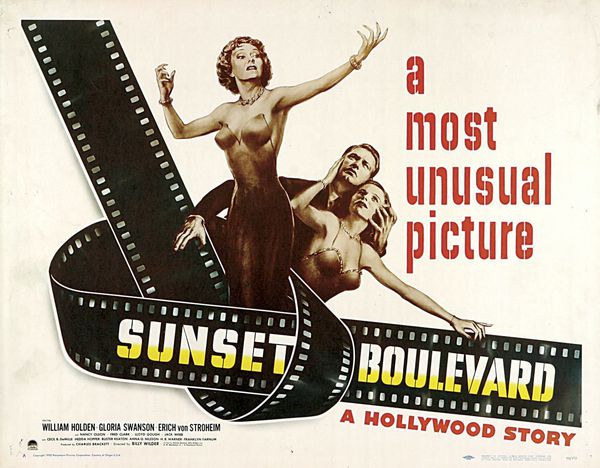
Sunset Boulevard is a drama about a down and out screenwriter, not really a film noir or is it?  William Holden is no criminal unless you count trying to keep his car from getting repossessed, but there are lies and betrayal, done, not out of greed or avarice, but out of love or at least empathy. Oh yeah, and you do have Holden face-down in the pool at the end.

Ace in the Hole is newspaper story about a reporter who will do anything to get back on top and the media circus that erupts around a trapped miner in a cave-in. The miner doesn't do very well, not as the result of lust or greed but for a byline. The end result is the same. No film noir there. Right?

Stalag 17 is a war movie about a scammer/borderline con man POW, who is framed for something he didn't do. The real traitor is a trusted member of the team flourishing in the midst of the other POWs. It's a war movie, right. Film noir is something totally different.

Witness for the Prosecution is a courtroom drama, but what happens. A man on the fringes of society kills a woman for her money and uses his wife as an alibi. Then ultimately he betrays his wife for another woman and gets his just desserts. Okay, that one sounds a bit more like film noir, but you don't really think about it because of the distraction of the trial.

Billy Wilder films are rarely just one thing. They take comedy and turns it into a drama. They take the elements of film noir and throw them into a drama or newspaper movie or a war movie or courtroom drama. And the end result is often much more than the sum of the parts.

Tuesday, July 25, 2017

Flash in the Upstairs Rear Window Apartment

I've been taking the TCM Presents The Master of Suspense: 50 Years of Hitchcock class on https://learn.canvas.net/courses/1679. One of the features of the class is a Daily Dose, a short clip from one of the films under study that is used to discuss certain aspects of the film. In one of the Daily Doses, the opening of Rear Window is shown. I have seen Rear Window somewhere in the neighborhood of 50 times, and there is something I had never noticed until I watched the Daily Dose this morning. 

It occurs approximately 1:30 measured from when James Stewart's name appears in the opening credits (Stewart's name appears before the title and is the first text in the opening credits). I chose this timing because I figured that different versions of the film would have different company logos tacked onto the front of the film. Anyway, at this point the film there is a slow pan of the apartments outside Jame Stewart's Rear Window. During the pan, there is a flash in the window, diagonally above the window where the couple is sleeping on the fire escape. 

I know that the apartments on the set were furnished and had working lights. It's possible that at just that moment a light bulb burned out. Possibly this was noticed and possibly not.  Maybe it was noticed but by the time they noticed it was too late to retake the shot, but I like to think that nothing in an Alfred Hitchcock film happens by accident. So if that flash was not an accident, that means that possibly there was another photographer living in the apartment across the way from James Stewart.

Now what would a photographer running a studio out of his or her apartment in Greenwich Village in 1954 be doing as a means of support? Taking portraits of the neighborhood kiddies? Well, considering there aren't many children in the neighborhood, it seems more likely that the other photographer might be doing something else that paid a little better, like girly pictures. Still, this seemed like a bit of a stretch, but you never know with Hitchcock. 

Then I decided to watch a little further. At  approximately 3:50 to 4:10 (again from James Stewart's name in the opening credits), while James Stewart is talking on the phone with his editor, you see this apartment again. Two women come out on the balcony wearing robes. They lie down on the balcony deck, and you see them drape their robes over the railing above the brick wall that borders that balcony. No indication is given as to whether the women are wearing bathing suits or birthday suits, but they are scantily clad enough to make a passing helicopter come what seems dangerously close to the roof of the building. So does that make the girly pictures thing seem a little less far fetched?


Motivated by this I decided to rewatch the whole film again in fast forward, looking for that window. It is shown again a number of times, but I didn't see anything that would lend more credence to my girly pictures theory. That window appears when the dog is killed. Two man-woman couples are standing in that window, when the woman is yelling about her dog. Nothing indicates that anything unusual is going on. Just two couples having dinner or whatever. Possibly, I'm just imagining things. Possibly, it is Hitchcock's private joke to himself. Likely, we will never know. 

But let's just say that I am right about this girly pictures thing. That means that the whole time James Stewart was obsessing over Miss Torso and worrying about Miss Lonelyheart's love life. He should have been looking in that top floor apartment, where the real action was going on. Then again, if he did that, Raymond Burr might have got away with murder. 

Tuesday, July 11, 2017

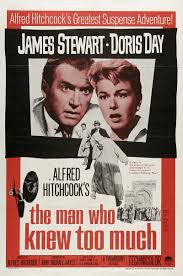
The Man Who Knew Too Much vs The Man Who Knew Too Much

Alfred Hitchcock made the film, The Man Who Knew Much twice:
  • The Man Who Knew Much (1934) – Made in England, and starring Leslie Banks, Edna Best, and Peter Lorre. Hitchcock considered this version the work of a talented amateur. For simplicity, I'll refer to this version as simply, 1934.

  • The Man Who Knew Much (1956) – Made in Hollywood, and starring James Stewart and Doris Day. Hitchcock considered this version the work of a professional. I'll refer to this version as 1956.

I always considered 1956 to be far superior, but I now realize that a lot of my problems with 1934 stem from seeing it on poor quality copies almost every time I watched it. Having recently seen a good copy of 1934, I've come to realize that I like both quite a bit. I still prefer 1956, but not by nearly as much as I had previously thought.

Between the two films, the basic story is the same but the way they are executed is enough different that watching one does not ruin your enjoyment of the other. Probably, the biggest difference is the ending, 1934 ends with a running gun battle, whereas, 1956 ends with 127 verses of the song, "Que Sera Sera." Remind me again, why I like 1956 better. Oh right, Jame Stewart and Doris Day.

Admittedly, the above is a bit facetious, but both film have their strengths and few if any weaknesses: 

  • 1934:
    • The pacing is excellent. It's a roller coaster ride, and even if there are parts that might seem a little hard to swallow, by the time you could even think that, you're already onto the next scene.
    • Peter Loree is a great actor, and he is kind of the prototypical Hitchcock villain, smart, refined, funny, and likable. If anything, he might be too likable, you kind of hate to see him go. 1956 doesn't really have a villian. Actually, it probably does, but I don't remember a thing about him. The couple that kidnap James Stewart and Doris Day's son are lower level, they take orders from someone, but I couldn't tell you who he was or anything about him. 
  • 1956:
    • Though 1956 doesn't have the break-neck pace of 1934 and adds scenes not in the original version, I never feel that it drags at all. The scenes that are added, though goofy in some respects, are hilarious, so you let it slide. The scene in the taxidermist shop and the friends waiting in their hotel for like 10 hours are stupid but in a fun way. Even Doris Day singing "Que Sera Sera" for 20 minutes still works  (okay, it wasn't that long).
    • Doris Day and James Stewart. For Doris Day, this is the movie that convinced me that she could really act, not just sing and do comedy, and James Stewart, it just doesn't get better than that. In 1934, I don't feel the anguish of the parents. That's what 1956 is all about, well that and the comedy. 
Both 1934 and 1956 are very good but for entirely different reasons.  I think Hitchcock is being too hard on himself with the talented amateur comment. Admittedly, Alfred Hitchcock made some films that are not good. 1934 is not one of them. It holds up well among any of the better Hitchcock films. I do still like 1956 better but 1934 is very good.

Thursday, March 9, 2017

Carl and Rob Reiner to Appear at TCMFF

Yesterday, TCM announced that the father-son duo of Carl Reiner and Rob Reiner will appear at the TCM Classic Film Festival (TCMFF) and be honored with a hand and footprint ceremony at the TCL Chinese Theater in Hollywood. In addition, Carl Reiner will introduce his film, The Jerk (1979), and Rob Reiner will introduce, The Princess Bride (1987). 

This is great news for TCMFF attendees, though I have a feeling that it might make festival choices that much more difficult. I saw Carl Reiner last year at TCMFF, and he was a hoot, lots of great stories.  Still, I saw The Jerk in the theater, so that might make me lean toward something else. I have never seen Rob Reiner in person, but The Princess Bride is one of those films that seems to always be showing somewhere, even in the fairly small number of art theaters in San Diego.  I know I'll have another chance to see it somewhere before too long. But Rob Reiner, that's another story. 

I'm already starting to stress out about the inevitable heart-breaking choices I'll have to make once the schedule drops. 

Friday, January 22, 2016

Star–Director Blogathon: Billy Wilder and William Holden, a Match Made in— Well, Probably Not Heaven

This post is part of the CLASSIC SYMBIOTIC COLLABORATIONS: The Star–Director Blogathon


If you had asked me 20 years ago who my favorite director was, I would have said, Alfred Hitchcock without batting an eye. If you asked me now, I still might say, Alfred Hitchcock, but I'd really have to agonize over it. Now, if this post is supposed to be about Billy Wilder, why am I talking about Alfred Hitchcock?

Well, I love Alfred Hitchcock, but he is kind of a one trick pony. It's a really really good trick, and nobody else can do that trick as well as he could. Likely, no one ever will. The reason I now have to agonize over my favorite director is that Billy Wilder could do it all, and nowhere is that more evident than his collaboration with William Holden. In the early to mid-1950s, the pair made three films together, and they about as far apart from each other as films could possibly be:

  • Sunset Blvd. (1950)
  • Stalag 17 (1953)
  • Sabrina (1954)
Two decades later, they teamed up again for, Fedora. The parallels between Sunset Blvd. and Fedora are obvious. If you haven't seen Fedora, it's not about a private eye. That's what the title suggested to me. It's about a movie star, Fedora, who retired and has been living in seclusion in Europe. Obviously, Fedora is two film greats way past their prime trying to recapture their glory days with a rehash of arguably their greatest film together. Or is it? I mean isn't William Holden's character basically the same person as in Sunset Blvd.

Well, except for that whole face-down-in-the-pool thing. Ooh, spoilers. Sorry. I'm going to assume that everyone has seen the first three films and not the last one. Probably, a fairly safe bet. With the exception of the face-down-in-the-pool comment above, I tend to avoid spoilers whenever possible. On Billy Wilder-William Holden pairings from the 1950s, there may be some minor spoilers. On Fedora, I'll do my best to have none.

Let's look at these films separately.

Sunset Blvd.


Like many of Billy Wilder's films, Sunset Blvd. is a bit hard to classify. IMDB calls it both Drama and Film Noir while Wikipedia refers to if as Black Comedy/Drama and Film Noir.  I think all of these work. Most of the comedy in the film stems from Norma Desmond (Gloria Swanson) saying very funny things that she doesn't realize are funny, or William Holden editorializing about the things she says or does. You feel like you are a bad person for laughing. So, yeah, Black Comedy works. At its heart, Sunset Blvd. is essentially a Tragedy. William Shakespeare couldn't have done better. So, Drama works as well. Film Noir, hmmm. Well, it doesn't have any hard-boiled private eyes. No back alleys or dark nightclubs, but where does most of the movie take place. A Beverly Hills mansion totally gone to seed. An architectural tribute to a bygone era. A mausoleum. How does the Holden voiceover describe the place. 

"The whole place seemed to have been stricken with a kind of creeping paralysis— Out of beat with the rest of the world, crumbling apart in slow motion."  

Sounds a bit Film Noir to me.  Oh yeah, then there's William Holden face down in the— Oops.

And what of the star? William Holden is a down-on-his-luck screenwriter. A former newspaper man who had come to Hollywood to write movies. With only a couple of B-pictures to his credit, he grinds out original stories, two a week, only to not have them sell. He's just an ordinary guy, trying make it in a very rough business. He's trying to avoid having to go back to his old job at the city desk of a Midwestern newspaper and admit to himself that he couldn't make it.

Leave it to Billy Wilder to take Film Noir, a genre that had barely been defined, and turn it on its ear. Look at the characters:

  • Joe Gillis (Holden), his only crime is wanting to make a living writing movies, unless you count missing a few car payments and trying to keep it from being repossessed
  • Norma Desmond (Swanson), delusional, unwilling to accept that the world has moved on
  • Max (Erich von Stroheim), out of love for Norma, he writes her fan mail, so that she can keep her illusions alive
  • Betty Schaefer (Nancy Olson), I like to think of her as an unjaded version of William Holden, before the Hollywood machine had beaten him. Of all the central characters, she's the one that comes through with the least scars. She only has to deal with losing William Holden and likely end up being married to Jack Webb.
None of them are bad people, they're all just twisted by forces beyond their control. If that's not Film Noir, I have no idea what is. There's a certain poetry to Sunset Blvd. from the first frame to the last. It's a masterpiece.

For the part of Joe Gillis, Marlon Brando, Fred MacMurray, and Montgomery Clift were also considered. Clift even signed to play the role and withdrew, claiming it was too close to the role he played in The Heiress. I think it might have worked with any of them. Fred MacMurray was possibly a bit old, only about 10 years younger than Swanson. I really think the age difference is a factor. Brando would have been mid-twenties, possibly a bit young. Montgomery Clift was only a couple of years younger than Holden, but I'm thinking he would have looked younger than Brando. Also, I always got an innocence and vulnerability from Clift. Joe Gillis is world weary and cynical. William Holden could do cynical like no one's business. I just don't see anyone being better in the role than William Holden. It was a signature role for him and his first nomination for an Academy Award.

Stalag 17

Here we have Billy Wilder's take on a War drama, but is about patriotism, comradery, or courage under fire? No, it's about greed and suspicion and betrayal. In a German prison of war camp, the men in a certain barracks always find that the Germans are one step ahead of them and suspect an informer in their midst. Suspicion falls on William Holden's character, Sgt. Sefton, because he always has some scheme going, selling cigarettes and holding gambling events, and using the profits to buy better food and treatment from the German guards. Like most Wilder films, it's a great story with a great cast of characters in roles both large and small, all executed with absolute precision. 

Stalag 17 was shot in sequence, in the same order as the final film. A rarity because it generally takes longer and is more expensive. Many of the actors didn't know about the final plot twist until they were about to shoot it. A former POW, William LaChasse, was hired in a bit part, and the production based much of the look of the camp on his recollections. Holden donned a crewcut and often went unshaven to downplay his looks and add to the gritty reality of the film.

Once again, William Holden was not the first choice for the role. Originally, Charlton Heston was considered. Then, Kirk Douglas was offered the role and turned it down, later saying it was the biggest mistake of his career. William Holden didn't want the part either. The film is based on a stage play. Holden walked out during the first act and later had to be coaxed into reading the screenplay. Still, he refused the role, but the studio bullied him into doing it. During production, William Holden was constantly trying to get Billy Wilder to make changes to the script to make his character more sympathetic. Wilder refused. 

The thing I love about William Holden is that he always have some sort of angle, making him perfect for that role of Sgt. Sefton, who knows all the angles. I really can't imagine anyone else in the role. Definitely, the character is unsympathetic, but Holden's natural charm keeps you on his side. And what did William Holden get out of it, only an oscar for Best Actor, beating out Burt Lancaster and Montgomery Clift in From Here to Eternity.


Sabrina


Sabrina with David (and William Holden)
Sabrina might be the weakest of the films being considered. Why? Because it's just a light comedy. It's fluff and doesn't have the edge that you'd expect out of a Billy Wilder comedy. Yet, the remake 40 years later had only a few minor tweaks to update it and works great. It's cute. It's funny. What more do you want from a comedy? There's a theme about differences in class, but nothing heavy handed. Originally, Cary Grant was cast to play the older Larrabee brother, Linus, and Humphrey Bogart was brought in as a last minute replacement. Personally, I think it works better with Bogart. I think it would be too easy for Audrey Hepburn to fall in love with Cary Grant. Having Bogart get the girl makes the story that much more touching for me.

I'm sure the role of the younger playboy brother, David, was not very demanding for William Holden. Then again, I can't imagine the roles being very demanding for anyone in the cast. When released several critics said they thought Holden would have been better playing Linus and a younger actor playing David. Again, I think you would have the same problem as with Cary Grant. Why wouldn't Audrey Hepburn fall in William Holden as the older brother. As it was, the casting was perfect. William Holden's charm and easy good looks are the perfect counterpoint to Bogart's craggy awkwardness. Only Billy Wilder could have Humphrey Bogart get the girl over William Holden and make it work.

Much of what you see online about the film involves Audrey Hepburn's clothes. I don't think that Sabrina was much more than a blip on the radar for either Billy Wilder or William Holden, but what a wonderful blip. If this is one of their lesser films for both Wilder and Holden, I only wish they had made 10 more each that were just as good.

Fedora


Fedora couldn't be more of a perfect bookend to the Billy Wilder-William Holden relationship if it tried. I hadn't seen it until about a week ago. I've been working my way through the later Billy Wilder films for the last couple of months. I'm only missing a couple of them (Avanti and Buddy Buddy). I have to say it's easily my favorite of the later Billy Wilder films. 

William Holden plays Dutch Detweiler, a down-on-his-luck film producer, trying to coax classic film star, Fedora, out of retirement. When Holden finds her living in seclusion on a small island in Greece, something is wrong. Fedora appears to be being held prisoner by her doctor (José Ferrer) and her benefactor, the Countess Sobryanski (Hildegard Knef). I honestly don't think I can go into much more detail on the plot without spoiling things. 

Fedora only saw limited release, prompting Billy Wilder to complain that the studio spent about $625 on marketing. Admittedly, Fedora is not a perfect film. I have a feeling that 1970s audiences found the voice-overs and flashback within a flashback structure old-fashioned and offputting. I was fine with it, but then again I watch a lot of old movies. My biggest problem was that it seem overly melodramatic. Billy Wilder had wanted Marlene Dietrich to play the role of Fedora, and Faye Dunaway as her daughter Antonia. I think that stronger casting of the female characters might have turned this flawed but interesting film into a truly great film. That wasn't meant to be. Dietrich apparently hated the book and thought the screenplay did little to improve it. It's not clear to me whether Faye Dunaway was seriously considered beyond Billy Wilder wanting her.

For William Holden, it was a good solid performance. Maybe not Network, but still.... So is Fedora a couple of has-beens clutching at straws? No, not really. Sure, no one is ever going to say it's a better film than Sunset Blvd., but it does have something to say Hollywood and the cost of fame. And that something is not the same thing that Sunset Blvd. says. In fact, it deals with something that Sunset Blvd. only hints at, the double standard in Hollywood with regard to male and female actors. Male actors are allowed to age gracefully. Female actors, not so much.

Thanks to Billy Wilder's skill, you buy Humphrey Bogart in Sabrina getting a girl far too young for him over the more or less age-appropriate and better looking. William Holden. Theresa Wright and Ida Lupino were both born the same year as William Holden. The year that Holden was nominated for Best Actor in Network. Theresa Wright did a made-for-TV called Flood, and appeared in a TV series called The Wide World of Mystery, in an episode titled "Terror in the Night." That same year, Ida Lupino made a film called Food of the Gods (about giant wasps). The fictitious Fedora, she did what many older actresses do when they don't want to co-star opposite giant insects. She tries to fade into the background and let her public remember her as she was. If you haven't seen Fedora, hint, it doesn't work out for her. 

Check out other posts in the CLASSIC SYMBIOTIC COLLABORATIONS: The Star–Director Blogathon


Tuesday, January 5, 2016

The Front Page (1974) – Cinematic Cover Song

Back in November, I took the train up to Hollywood to see the preview of the TCM/Bonhams classic movie auction. I was only in town for about 4 or 5 hours before I had to jump the train back to San Diego. Whenever I'm up there I like to stop at Amoeba Records, a huge music store. Normally, when I'm there, I spend the entire time looking for music, but they also have movies upstairs. This was the first time I'd ever gone upstairs. 

I ended up buy six DVDs, three of which were from one my favorite directors, Billy Wilder. Of the three, two were later films that they rarely show these days, The Private Life of Sherlock Holmes (1970) and the subject of this post, The Front Page (1974). I just got around to watching The Front Page about a week ago.

Before I go on, I want to cover the genealogy of The Front Page. The Front Page was originally a hit play on Broadway, co-written by  Ben Hecht and Charles MacArthur. It was considered one of the better plays of 1928 and has been adapted to film four times:

  • The Front Page (1931) – Though not extremely well-known today, this version, directed by Lewis Milestone and starring Adolphe Menjou and Pat O'Brien, was nominated for three Oscars for Best Picture and Best Director and one nomination for Adolphe Menjou as Best Actor (lost all three)
  • His Girl Friday (1940) –  Easily the best known of the remakes today, with the key difference being having the reporter Hildy Johnson be a woman (Rosalind Russell) and the ex-wife of the editor Walter Burns (Cary Grant).
  • The Front Page (1974) – This version directed by Billy Wilder and starring Jack Lemmon and Walter Matthau in the lead roles goes back to the original play with Lemmon as the reporter and Matthau as the editor.
  • Switching Channels (1988) – This version draws from both The Front Page and His Girl Friday and stars Kathleen Turner, Burt Reynolds, and Christopher Reeve. I haven't seen this version and didn't even know it existed until I started researching for this post. The film was considered a failure, and was nominated for two Golden Raspberry Awards, Burt Reynolds (Worst Actor) and Christopher Reeve (Worst Supporting Actor). Now, that I know of it, I really want to see it despite it likely being very bad.

Of these adaptations, there's only one I really know well, His Girl Friday. I'm sure I've seen it easy fifty to a hundred times. I can recite bits of the dialog word-for-word. Before last week, I can't say for sure whether I had seen 1931 version of The Front Page. I probably saw the 1974 version as a kid, when it was shown on TV a year or two after it was released, but if I did, it didn't make a big impression on me, at least, not like other Jack Lemmon/Walter Matthau movies, anyway.

About a week ago, I sat down and watched the 1974 Billy Wilder remake of The Front Page (I also watched the 1931 version as well). Wilder didn't consider it one of his better films and is probably right. For me though, as I watched it (either for the first time as an adult or possibly the first time period), it struck me that this was like listening to a really cool cover version of a song you really like.

I love cover songs. I have hundreds and hundreds of them. In the days of dollar used CDs bins, I often buy albums by a band I barely know because I notice a cover of a song I really like. I think the problem with cover songs, when they go awry, is that they fail to distinguish themselves from the original. Who wants to hear the song played with the same arrangement with only a different singer or more distortion on the guitar solo that is note-for-note the same as the original. Sometimes, it doesn't take very much to make it work, like a singer with a different timber to his voice or female vocals on a song you know from a male singer. My favorite covers are always the ones where the artist takes the song in a completely different direction, like Joey Ramone's version or the Louis Armstrong hit, "What a Wonderful World."

The dialog in the two versions of The Front Page and His Girl Friday is 80% to 90% the same, so seeing the 1974 Billy Wilder version, where I can recite the lines from His Girl Friday by heart, was like hearing a song I love with a different singer who just nails it. 

Billy Wilder didn't like remakes of films, saying "... if a picture is good, you shouldn't remake it, and if it's lousy, why remake it?" It appears that he agreed to do the remake because he had once been a newspaper man himself and thought it was a glamorous profession. Personally, I have a feeling that he went back to the original play rather than His Girl Friday, because he wanted to distinguish his film from the better known version. In that respect, it really works. Knowing Hildy Johnson, as tough dame, hearing her words from a man works in the same way hearing the lyrics from a song you love coming from a singer of the opposite gender.

The cast is awesome. Screen teams just don't get much better than Jack Lemmon and Walter Matthau. Is it their best work together?  Frankly, no, but some of it comes across brilliantly. Seeing Susan Sarandon in only her fifth film role as Hildy's love interest (remember, Hildy is a man in this version) is a treat. The part of Mollie Malloy is played by none other than Carol Burnett, and it was great to see her in something real and not just a 10-minute bit from her TV show, though the part consists of about the same screen time as one or two of her TV sketches. 


Left to right: Dick O'Neill, David Wayne, Charles Durning, and Allen Garfield
The rest of the cast is almost a who's who of 1970s character actors, Vincent Gardenia as the Sheriff, Harold Gould as The Mayor, and Charles Durning, Herb Edelman, Lou Frizzell, Dick O'Neill, and Allen Garfield as reporters. If you don't know these names, you will surely recognize the faces. Rounding out the cast is David Wayne as Roy Bensinger (the reporter whose desk murderer Earl Williams hides for much of the third act). Aside from the gender switch or switchback if you prefer, one of the few changes is to make the character of Bensinger, gay. Possibly this is in the original stage play, but unless I missed it wasn't even hinted at in The Front Page (1931) or His Girl Friday.

In retrospect, is Billy Wilder's 1974 The Front Page as good as His Girl Friday? No, not even close. Is it as good as one of Wilder's other better films (I can rattle off about a dozen without cheating)? Again, no, not even close. But here's the thing with really great artists, even their bad stuff is well worth a look. That's definitely the case here.

Tuesday, November 24, 2015

The Railrodder – Buster Keaton’s Last Silent Film from 1965, Wait, What?

I stumbled on the The Railrodder when I was looking at the IMDB page for Buster Keaton. The film was released in 1965 and made in conjunction with the documentary, Buster Keaton Rides Again. Both were produced by the National Film Board of Canada. Buster Keaton Rides Again is a making of film about the production of The Railrodder, though it is twice the length of The Railrodder. Buster Keaton Rides Again is as much a documentary about Keaton’s life as it is a making of.

In The Railrodder, Buster Keaton is a in London reading a newspaper. He sees an ad that says, SEE CANADA NOW! He throws away the paper and jumps off a bridge into the Thames. The next shot he is emerging on a beach in Nova Scotia.  After seeing a sign pointing West and saying Pacific Ocean 3982 ½ miles, he starts to walk along the railroad tracks. He comes on a speeder, an open one seat railroad maintenance vehicle. The seat looks comfy, so he decides to take a nap and accidentally puts it in gear. Off he goes. The rest of the film is a series of gags, following him across the continent.

The Railrodder is definitely a silent film. There isn’t a single word of dialog, only music and overdubbed sound effects. The speeder in addition to having an inexhaustible fuel supply also has a Tardis-like storage cabinet. A running gag throughout the film is him pulling everything from his signature pork-pie hat to a tea set to a blanket and pillow from the tiny cabinet. Keaton celebrated his 69th birthday during the filming. While he is not falling off any buildings, he is clearly doing his own stunts, I presume with the exception of the jumping off the bridge. He certainly had not lost his feel for physical comedy.

The Railrodder is credited as, Written and Directed by Gerald Potterton. Watching the documentary, Buster Keaton Rides Again, it’s clear that he wrote/improvised most of the gags and surely co-directed with Potterton. I honestly don’t think he cared about the writing/director credits. The documentary clearly shows how he worked. The Railrodder is a wonderful short film.

I have embedded The Railrodder below:


Both the The Railrodder and Buster Keaton Rides Again are available for streaming free from National Film Board of Canada’s YouTube page at the links below:


Friday, October 16, 2015

Dial M for Murder in 3D

Last night, I had a chance to see Dial M for Murder in the theater. It's not my favorite Hitchcock movie. I don't think it would even crack the top 10. Still, how often do you get to see Hitchcock in the theater, so I went. They were showing it in 3D, which I probably wouldn't have gone out of my way for, but originally they released the film in 3D, so I figured, what the hey. 

Now, I have to say I'm not real big on 3D. I'm old. When I was young, 3D involved cardboard glasses that had blue and red cellophane lenses. It really more weird than 3D. What Avatar came out, I didn't bother to see it in 3D. Why should I? It wasn't that great of a movie in regular D. Why would I pay extra to see it a second time in 3D? Of course, after that, the movie industry went completely ape shit on 3D. Still, you had the option of regular D or 3D, and I always went for regular D. The result was that, aside from a demo at the Sony Store, the
 only real modern 3D I've ever seen was "Captain Eo" at Disneyland probably 20 years ago. Then again, that was basically a long music video with cutesy aliens floating above your head.

This was a new experience for me. I would like to say that it was incredible seeing Grace Kelly on the big screen and in 3D. I would like to say that it felt like I could just reach out and touch her boobs. But I can't. It was kind of a cool effect. When you looked at Grace Kelly, she was clearly at a different object on a different plane than what was in the background or the foreground if she was standing in front of a desk or something. Very cool, and on a certain level, quite impressive. And when she reached out toward the audience like in the poster above, it sort of looked like her hand was coming toward you. But mostly, it just looked weird. On the whole, it was distracting. And annoying. And when I left the theater, I felt slightly sick in the stomach. I guess I'll give it another 20 years before I do 3D again. Maybe, by then, they'll have figured out the boob thing.

Monday, October 12, 2015

Hollywood's Hispanic Heritage Blogathon – Born in East L.A.

This post is part of the ¡De Película! Hollywood’s Hispanic Heritage Blogathon, sponsored Aurora over at Once Upon a Screen. Please check out her site at the link below for releated posts.

Written, directed, and starring Cheech Marin, Born in East L.A. is not going to make anybody's top 10 list or even top 100 list. Still, there's way more to it than just a novelty song made into a movie or a Cheech and Chong movie minus Chong. But does Born in East L.A. really belong in a blogathon about Hispanic Heritage movies?

I would say, yes. The entire movie is about Mexican-American culture and what it means to be from East L.A. And how that's different from being Mexican. It doesn't really deal with American culture. It doesn't need to. The assumption is that the audience knows American culture, and there's an underlying assumption that Mexican-American culture and Mexican culture are one and the same. Born in East L.A. shows just how that is not the case. Sure, Mexico culture and Mexican-American culture have a lot of similarities, but Born in East L.A. shows just how different they are in a hundred ways.

Now I have to say, I was a little worried about Born in East L.A. I hadn't seen it in about 10 or 12 years, and I was worried that maybe it wouldn't hold up. Sometimes, you see a movie after a long time and it's just not as good as you remember it being. I'm glad to say that was not the case to here. I laughed a lot watching it in preparation for this blogathon. Sure, some of the humor was crude and sexist but show me at comedy from the 80s that isn't.

In what follows, there will be spoilers. If you heard the song "Born in East L.A.," you pretty much know the premise of the movie. Still if you were one of those people who don't want to hear any details about a movie you haven't seen, you should stop right now and scroll past the End of spoilers heading below.

Cheech Marin plays Rudy Robles, a guy from East LA, who installs car stereos. On his way home from work, he is supposed to pick up his cousin who's just come in from Mexico. Of course, he forgot his wallet that day, so when he ends up in a Migra (U.S. Immigration) raid, he is is deported to Mexico. He tries to explain that he's an American citizen, but since he doesn't have his ID, he can't prove it. Sound a little bit far fetched, not to me, it doesn't. If you are brown skinned and are arrested with bunch of illegal aliens and have no way of proving that you aren't illegal, would anybody really believe you?

At the border, he tries to explain who he is but when they look him up in the computer, he shares the same name as someone has been arrested and deported a dozen times. The immigration official says that if he needs to make a phone call to get his ID and prove who he is, he can do so out there, in Mexico. 

Thus, Rudy ends up in Tijuana with no ID and no money and no way of getting back.
He tries to call home but then remembers that his family is out of town and gets answering machines whenever he tries to call anyone else. Of course he's in Mexico for a period of weeks or even months. Presumably, he could call call a dozen times a day, and eventually he  would get a live person who could make arrangements to get him his ID, but that would make for a very short and unfunny movie. The humor centers on Rudy efforts to get back to the U.S., but it's really about how he doesn't fit in down there, and how much different it is being a Mexican American than being Mexican.

Rudy meets Daniel Stern, an American expatriate who lives in Tijuana because of something he did illegal up here. Rudy gets various jobs from Stern, everything from getting people into a bar for ten cents a head to selling fake passports and green cards. There's also a great sequence where he tries to teach some OTMs (illegal immigrants who are Other Than Mexican) how to fit in up in East LA. These Asian immigrants have jobs up in the East L.A. but they keep getting deported because they can't fit in. Rudy teaches them how to blend in to East L.A. with pretty hilarious results.

He also meets and falls in love with Delores, played Kamala Lopez, an El Salvadoran immigrant, who like Rudy works multiple jobs, trying to earn enough money to get to the U.S. Cheech Marin and Lopez have good chemistry together, and their romance works for me.

There's a really great sequence where Rudy tries to get back to the US as a pollo (chicken), a Mexican national who tries to get over the border by just running across and avoiding the Border Patrol. Of course, he always gets caught in a series of sight gags, that work on much the same level as a silent comedy. Stupid, but very funny.

He also hooks up with a mariachi band and helps them earn more money by teaching them American songs, including "Twist and Shout," which they already know as "La Bamba," basically the same song. At one point he helps them earn a lot of money by playing "Roll Out the Barrel" and singing it in German for some German tourists. Yes, Rudy knows how to speak German because he was stationed in Germany in the Army (he was being all he could be, but all they would let him be was a mechanic). Yet, he can barely speak Spanish because he never had to.

Rudy comes to realize that even though it sucks being stuck down there. He is still way better off than most of the people south of the border. He does these acts of  tremendous charity, that may seem sappy, but work for me. Ultimately Rudy and Delores make it to the U.S. and East L.A., bringing his former OTM students with them. (They are able to bluff their way passed a cop because of what Rudy taught them.)

There is a slightly different ending where Rudy and Delores get kidnapped and held for ransom by coyotes, criminals who transport illegal immigrants in the U.S. This wasn't in the version I just watched. I assume it was buried in the Special Features on the DVD. 

End of Spoilers

The critics didn't like Born in East L.A. I think they were expecting another Cheech and Chong movie, or at least humor like you'd find in a Cheech and Chong movie. That's not what Born in East L.A. is all about. Sure there's some over-the-top ridiculous humor, but there's also humor that is subtle and nuanced, as well as scenes that are touching and emotional. I don't think critics were expecting that out of Cheech Marin, and as a result, they gave the movie poor reviews.

Born in East L.A. is not the greatest movie of you will ever see, but it works for me on a lot of different levels. It's about Mexican American culture and ultimately, how it's not the same thing as Mexican culture, despite with society might think. The very thing that the critics disliked about Born in East L.A. is exactly what make me like it as well as I do.

############

Please check out Aurora's site for related posts in the Hollywood's Hispanic Heritage Blogathon at Once Upon a Screen:


Friday, June 5, 2015

µBlog – Opening Fritz Lang's M

µBlog – Too long to tweet, too short to call a real post

I'm taking the TCM/Ball State University course, Into the Darkness: Investigating Film Noir. The first assignment other than reading the syllabus etc. was to look at the following video, of the opening four or so minutes of Fritz Lang's M. We were supposed to look at what contribution it makes to film noir style.


What I am most struck by here is not the way this relates to film noir, but just how well crafted the story-telling is. Basically the entire sequence is exposition, setting up the situation and elaborating on every aspect of it. From the innocence of the children, making a game out of the threat to them, to the adult's paranoia, the one woman appalled by the children making light of the situation, while the other woman is comforted by just knowing they are still there. The adults waiting outside the school, when normally they would probably let the children walk. By the time, you get to the poster at the end, you don't even need to know the details. You already know everything that counts. Yes, there is some film noir imagery, the ominous shadows of the cuckoo clock and the man at the end. What really stands out to me is just damn good story-telling. People aren't explaining the situation. They're reacting to it. Brilliant. I love this movie.

Wednesday, May 6, 2015

Wonder Con 2015, the Master of Suspense, and Other Stuff

The weekend after the TCM Classic Film Festival was Wonder Con. In the category of, You Never Know What You Are Going to Find at a Comic Convention, this year at Wonder Con, I found Hitchcock. It started when I was wandering a section of the Exhibit Hall that was mostly celebrities. Now, these tend to not be big names or even names you would recognize. They tend to be people who starred in low budget Sci-Fi and Horror movies in the 70s and 80s or played aliens on one of the Star Trek series. These are not going to be people you would stop on the street. Sure, if you are a fan of their stuff, you'd pay twenty bucks for a signed photo. Me, I tend to be fairly ambivalent to this sort of thing, but as I was walking along I saw a color representation of this:


A little background, the shower scene in Alfred Hitchcock's Psycho runs 3 minutes and has about 50 cuts. There is just one shot (above) where you see the knife against bare skin. I've known for quite a while that it was not Janet Leigh's stomach there. They used a body double. Walking around that section at Wonder Con roughly 55 years after the film's release, I was standing in front of the girl in Hitchcock's shower, Marli Renfro (Janet Leigh's body double from the shower scene). I don't normally buy autographs but the connection to Psycho was just too cool to pass up. Refro is a former Playboy model/Bunny and appeared in a number of other men's magazines. Of course, I had to buy the picture and have her autograph it to me:


The inscription reads, Hi Chris -- Be careful in taking a shower! Marli Renfro
I'm sure she came up with that just for me.

I also took a picture with her:


Marli and me

I tried to get her to get her to show me her stomach, but she kept saying that I didn't want to see it, and I kept saying that I did. And I really did. Doing the math, she's somewhere in her mid-70s. So sure, I might have regretted it afterwards, but I would have wanted to see it anyway. Yes, I'm a pig. I know that. I toyed with the idea of asking her again the last day of the show, but realized that pestering a senior citizen to show skin was kind of a dick move. I decided to just say goodbye and that it was nice meeting her. 

Oddly, there was also someone else at Wonder Con doing cosplay of Alfred Hitchcock's The Birds. I didn't see them, but I had multiple people tell me about it and did get a photo:


The Birds cosplay, thanks, Anastasia, for the photo

Beyond that, I also saw a guy cosplaying the man with no name.

Clint Eastwood, eat you heart out

That's three, count 'em, three people doing classic film cosplay. Not bad for a comic convention.

Now, you may have noticed the cowboy hat in the picture above. I got that done at Comic-Con last year. Details here. The reason I bring it up is that I decided to do another one, that is all classic film related. I got it started at Wonder Con and hope to finish it up at Comic-Con this year. I only got three pieces done, but it's a start.


First piece was the TCM logo by Scott Koblish

TCM logo, up close, blue tape is to indicate where the hatband will go


 Chuck Wojtkiewicz and King Kong (he also did the Comic-Con logo on the cowboy hat)

King Kong, up close

Alex Hoffman and North by Northwest

North by Northwest, up close

Wednesday, February 25, 2015

My Sister's Psycho Quilt

My sister Laura is a quilt artist. Normally, when you think of when you think of quilts, you think of geometric patterns and colonial designs. My sister's stuff, not so much. I was visiting with her last weekend, and we were talking about old movies.

She told me that she had been running in a challenge for her local quilt group, where everybody in the group would do a quilt built around a certain theme. It was her turn to pick the topic for the theme. She picked movies.

Her first thought was Fantasia. Then she found out that Disney was very picky about letting people use their characters. Not just picky, really, they didn't want people to use their characters at all. If they caught somebody using their characters, they would make them take down not just the single piece of art that had the Disney characters, but would shut down the entire show.

Since she didn't want to take a chance on having the show shut down, much less get sued by Disney, she had to come up with something else. She had already started the Fantasia quilt, so she decided to turn it into a Psycho quilt.

Makes perfect sense, right? Well, here it is.

Full quilt, size is about 3 feet square 

Detail – Owl, Patrolman, and Norman's eye

Detail – The Shower

Detail – The Fly, lettering in green is a bit hard to read, but says, "... she wouldn't even hurt a fly"