Showing posts with label Billy Wilder. Show all posts

Tuesday, October 31, 2017

Billy Wilder and Film Noir

I just thought of something. One of my favorite film directors is Billy Wilder, and the main reason for this is that he is so versatile. He could do drama. He could do comedy. He could do could do film noir. He could do a courtroom drama or a war movie, but more importantly he could move freely between these genres and mix and match as the story demands.

Often what makes a Billy Wilder movie great is they way it touches on many genres. Some Like It Hot is not just a comedy, it's also a drama and a gangster movie all rolled into one. And it probably says more about sex and gender roles than many films would for years to come.

If you asked me about the quintessential film noir, I would have to say The Maltese Falcon, but running a close second would have to be Double Indemnity. Both are great examples of films noir. In a way, I think I prefer, Double Indemnity. Edward G. Robinson lends a level of humanity that is somewhat lacking in The Maltese Falcon, but at the same time Walter Neff and Phyllis Dietrichson are every bit as corrupt or corrupted as anyone in any film noir ever.

But let's look at some of his other films, ones that you may not think of as film noir.

*** Warning Spoilers Ahead ***


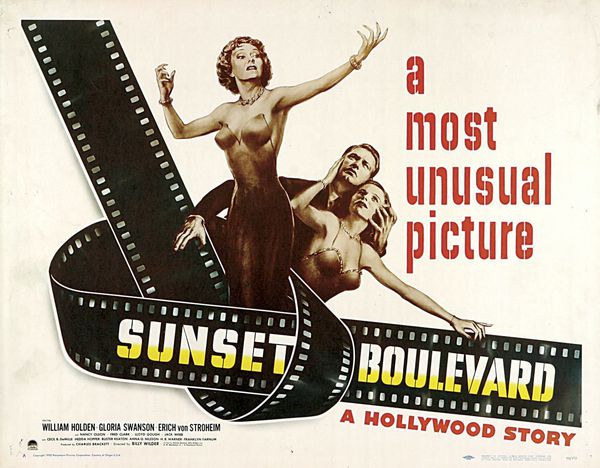
Sunset Boulevard is a drama about a down and out screenwriter, not really a film noir or is it?  William Holden is no criminal unless you count trying to keep his car from getting repossessed, but there are lies and betrayal, done, not out of greed or avarice, but out of love or at least empathy. Oh yeah, and you do have Holden face-down in the pool at the end.

Ace in the Hole is newspaper story about a reporter who will do anything to get back on top and the media circus that erupts around a trapped miner in a cave-in. The miner doesn't do very well, not as the result of lust or greed but for a byline. The end result is the same. No film noir there. Right?

Stalag 17 is a war movie about a scammer/borderline con man POW, who is framed for something he didn't do. The real traitor is a trusted member of the team flourishing in the midst of the other POWs. It's a war movie, right. Film noir is something totally different.

Witness for the Prosecution is a courtroom drama, but what happens. A man on the fringes of society kills a woman for her money and uses his wife as an alibi. Then ultimately he betrays his wife for another woman and gets his just desserts. Okay, that one sounds a bit more like film noir, but you don't really think about it because of the distraction of the trial.

Billy Wilder films are rarely just one thing. They take comedy and turns it into a drama. They take the elements of film noir and throw them into a drama or newspaper movie or a war movie or courtroom drama. And the end result is often much more than the sum of the parts.

Saturday, June 11, 2016

Order in the Court Blogathon - Witness for the Prosecution

This post is an entry in the Order in the Court Blogathon hosted by Second Sight Cinema and Cinemaven's Essays from the Couch.


What can I say about Witness for the Prosecution other than it is a great movie. There is a surprise ending. That is all I'm going to say. Well, yes, I do need to discuss aspects of the plot, but I'll avoid even hinting at it. The end of the film was even kept secret to the cast and crew. According to IMDB, the principal actors did not learn the ending until the final day of shooting, when the last ten pages of the script was given to them. The film contains a disclaimer over the closing credits, asking audience members to not reveal the ending. It was reported that at a Royal Command Screening of the film, members of the Royal family were asked to promise to not reveal the ending. Even the movie poster urged viewers to not reveal the ending.`

Witness for the Prosecution is an adaptation of an Agatha Christie play of the same name, based on one of her early short stories. Christie said it was the only film adaptation of her work that she actually liked. Years later, she said similar of Murder on the Orient Express (1974). Tyrone Power said it was one of only three movies he was particularly proud of. The film was nominated for 6 Oscars: 
  • Best Picture
  • Best Actor for Charles Laughton 
  • Best Supporting Actress for Elsa Lanchester 
  • Best Director for Billy Wilder 
  • Best Sound, Recording
  • Best Film Editing
Conspicuous in its absence is the lack of a nomination for Marlene Dietrich as Best Actress. Her performance ties into the surprise ending, and the studio downplayed her role to keep the film's secret. Dietrich was devastated by the snub. The film also was nominated for five Golden Globes, including a win for Elsa Lanchester as Best Supporting Actress and a nomination for Marlene Dietrich as Best Actress.


***************
*** The following paragraph contains minor spoilers of the plot. ***
***************

Tyrone Power plays Leonard Vole, a man accused of murder, but who maintains his innocence. Charles Laughton is a lawyer fresh out of the hospital after recovering from a heart attack, under strict orders to avoid anything strenuous, such as a murder trial. After discussing the case with Power, Laughton believes him and agrees to take the case, at least partially to get out from under the thumb of his overbearing nurse, played by Laughton's real-life wife, Elsa Lanchester. Power is something of a ne'er do well, unable to hold a job, and is accused of murdering a rich widow he befriended. Tyrone Power's wife (Marlene Dietrich) is a former cabaret singer, that he rescued from the rubble of Post-War Germany, and she is portrayed as a gold digger.


From what I read, critics thought that Tyrone Power was too old for the role of Leonard Vole. It never even occurred to me. He seemed age-appropriate for Marlene Dietrich (in reality, he was more than ten years younger than Dietrich). According to IMDB, Dietrich had a crush on Power during the filming, and Billy Wilder said that Charles Laughton had a crush on Power as well. Personally, I like him in the role. He is good as the bewildered man accused of a crime he didn't commit.

Witness for the Prosecution has to be my favorite role for Marlene Dietrich. She is absolutely great. Looking at the other nominees for best actress that year, it's a crime that she was not at least nominated. Charles Laughton is brilliant as the lawyer. His character combines a keen legal mind with the personality of a mischievous little boy as he sneaks brandy and cigars, whenever his nurse's back is turned. Elsa Lanchester is one of my favorite character actress. She has a way of making an impression in a small role and that is surely the case here. Rounding out the cast are Norma Varden as the murdered widow and Una O'Connor as her maid. Both are great.

I don't want to discuss details of the case for fear of giving away too much of the plot. It is interesting that the film is set in England, to see the differences in their legal system, most notably the judge and barristers (lawyers) wearing wigs. 

The twist ending is one of the best ever filmed. I totally did not see it coming. With a director like Billy Wilder, it's easy to overlook really great films over their more famous films. I think that is at least somewhat the case here. Billy Wilder has a way of turning genre films on their ears, film noirs that are about people who aren't really criminals or comedies with a sense of pathos. In Witness for the Prosecution, Wilder combines a murder mystery with interesting characters and tosses in a great ending. The results are spectacular and one of the best courtroom dramas ever put on film.

Friday, January 22, 2016

Star–Director Blogathon: Billy Wilder and William Holden, a Match Made in— Well, Probably Not Heaven

This post is part of the CLASSIC SYMBIOTIC COLLABORATIONS: The Star–Director Blogathon


If you had asked me 20 years ago who my favorite director was, I would have said, Alfred Hitchcock without batting an eye. If you asked me now, I still might say, Alfred Hitchcock, but I'd really have to agonize over it. Now, if this post is supposed to be about Billy Wilder, why am I talking about Alfred Hitchcock?

Well, I love Alfred Hitchcock, but he is kind of a one trick pony. It's a really really good trick, and nobody else can do that trick as well as he could. Likely, no one ever will. The reason I now have to agonize over my favorite director is that Billy Wilder could do it all, and nowhere is that more evident than his collaboration with William Holden. In the early to mid-1950s, the pair made three films together, and they about as far apart from each other as films could possibly be:

  • Sunset Blvd. (1950)
  • Stalag 17 (1953)
  • Sabrina (1954)
Two decades later, they teamed up again for, Fedora. The parallels between Sunset Blvd. and Fedora are obvious. If you haven't seen Fedora, it's not about a private eye. That's what the title suggested to me. It's about a movie star, Fedora, who retired and has been living in seclusion in Europe. Obviously, Fedora is two film greats way past their prime trying to recapture their glory days with a rehash of arguably their greatest film together. Or is it? I mean isn't William Holden's character basically the same person as in Sunset Blvd.

Well, except for that whole face-down-in-the-pool thing. Ooh, spoilers. Sorry. I'm going to assume that everyone has seen the first three films and not the last one. Probably, a fairly safe bet. With the exception of the face-down-in-the-pool comment above, I tend to avoid spoilers whenever possible. On Billy Wilder-William Holden pairings from the 1950s, there may be some minor spoilers. On Fedora, I'll do my best to have none.

Let's look at these films separately.

Sunset Blvd.


Like many of Billy Wilder's films, Sunset Blvd. is a bit hard to classify. IMDB calls it both Drama and Film Noir while Wikipedia refers to if as Black Comedy/Drama and Film Noir.  I think all of these work. Most of the comedy in the film stems from Norma Desmond (Gloria Swanson) saying very funny things that she doesn't realize are funny, or William Holden editorializing about the things she says or does. You feel like you are a bad person for laughing. So, yeah, Black Comedy works. At its heart, Sunset Blvd. is essentially a Tragedy. William Shakespeare couldn't have done better. So, Drama works as well. Film Noir, hmmm. Well, it doesn't have any hard-boiled private eyes. No back alleys or dark nightclubs, but where does most of the movie take place. A Beverly Hills mansion totally gone to seed. An architectural tribute to a bygone era. A mausoleum. How does the Holden voiceover describe the place. 

"The whole place seemed to have been stricken with a kind of creeping paralysis— Out of beat with the rest of the world, crumbling apart in slow motion."  

Sounds a bit Film Noir to me.  Oh yeah, then there's William Holden face down in the— Oops.

And what of the star? William Holden is a down-on-his-luck screenwriter. A former newspaper man who had come to Hollywood to write movies. With only a couple of B-pictures to his credit, he grinds out original stories, two a week, only to not have them sell. He's just an ordinary guy, trying make it in a very rough business. He's trying to avoid having to go back to his old job at the city desk of a Midwestern newspaper and admit to himself that he couldn't make it.

Leave it to Billy Wilder to take Film Noir, a genre that had barely been defined, and turn it on its ear. Look at the characters:

  • Joe Gillis (Holden), his only crime is wanting to make a living writing movies, unless you count missing a few car payments and trying to keep it from being repossessed
  • Norma Desmond (Swanson), delusional, unwilling to accept that the world has moved on
  • Max (Erich von Stroheim), out of love for Norma, he writes her fan mail, so that she can keep her illusions alive
  • Betty Schaefer (Nancy Olson), I like to think of her as an unjaded version of William Holden, before the Hollywood machine had beaten him. Of all the central characters, she's the one that comes through with the least scars. She only has to deal with losing William Holden and likely end up being married to Jack Webb.
None of them are bad people, they're all just twisted by forces beyond their control. If that's not Film Noir, I have no idea what is. There's a certain poetry to Sunset Blvd. from the first frame to the last. It's a masterpiece.

For the part of Joe Gillis, Marlon Brando, Fred MacMurray, and Montgomery Clift were also considered. Clift even signed to play the role and withdrew, claiming it was too close to the role he played in The Heiress. I think it might have worked with any of them. Fred MacMurray was possibly a bit old, only about 10 years younger than Swanson. I really think the age difference is a factor. Brando would have been mid-twenties, possibly a bit young. Montgomery Clift was only a couple of years younger than Holden, but I'm thinking he would have looked younger than Brando. Also, I always got an innocence and vulnerability from Clift. Joe Gillis is world weary and cynical. William Holden could do cynical like no one's business. I just don't see anyone being better in the role than William Holden. It was a signature role for him and his first nomination for an Academy Award.

Stalag 17

Here we have Billy Wilder's take on a War drama, but is about patriotism, comradery, or courage under fire? No, it's about greed and suspicion and betrayal. In a German prison of war camp, the men in a certain barracks always find that the Germans are one step ahead of them and suspect an informer in their midst. Suspicion falls on William Holden's character, Sgt. Sefton, because he always has some scheme going, selling cigarettes and holding gambling events, and using the profits to buy better food and treatment from the German guards. Like most Wilder films, it's a great story with a great cast of characters in roles both large and small, all executed with absolute precision. 

Stalag 17 was shot in sequence, in the same order as the final film. A rarity because it generally takes longer and is more expensive. Many of the actors didn't know about the final plot twist until they were about to shoot it. A former POW, William LaChasse, was hired in a bit part, and the production based much of the look of the camp on his recollections. Holden donned a crewcut and often went unshaven to downplay his looks and add to the gritty reality of the film.

Once again, William Holden was not the first choice for the role. Originally, Charlton Heston was considered. Then, Kirk Douglas was offered the role and turned it down, later saying it was the biggest mistake of his career. William Holden didn't want the part either. The film is based on a stage play. Holden walked out during the first act and later had to be coaxed into reading the screenplay. Still, he refused the role, but the studio bullied him into doing it. During production, William Holden was constantly trying to get Billy Wilder to make changes to the script to make his character more sympathetic. Wilder refused. 

The thing I love about William Holden is that he always have some sort of angle, making him perfect for that role of Sgt. Sefton, who knows all the angles. I really can't imagine anyone else in the role. Definitely, the character is unsympathetic, but Holden's natural charm keeps you on his side. And what did William Holden get out of it, only an oscar for Best Actor, beating out Burt Lancaster and Montgomery Clift in From Here to Eternity.


Sabrina


Sabrina with David (and William Holden)
Sabrina might be the weakest of the films being considered. Why? Because it's just a light comedy. It's fluff and doesn't have the edge that you'd expect out of a Billy Wilder comedy. Yet, the remake 40 years later had only a few minor tweaks to update it and works great. It's cute. It's funny. What more do you want from a comedy? There's a theme about differences in class, but nothing heavy handed. Originally, Cary Grant was cast to play the older Larrabee brother, Linus, and Humphrey Bogart was brought in as a last minute replacement. Personally, I think it works better with Bogart. I think it would be too easy for Audrey Hepburn to fall in love with Cary Grant. Having Bogart get the girl makes the story that much more touching for me.

I'm sure the role of the younger playboy brother, David, was not very demanding for William Holden. Then again, I can't imagine the roles being very demanding for anyone in the cast. When released several critics said they thought Holden would have been better playing Linus and a younger actor playing David. Again, I think you would have the same problem as with Cary Grant. Why wouldn't Audrey Hepburn fall in William Holden as the older brother. As it was, the casting was perfect. William Holden's charm and easy good looks are the perfect counterpoint to Bogart's craggy awkwardness. Only Billy Wilder could have Humphrey Bogart get the girl over William Holden and make it work.

Much of what you see online about the film involves Audrey Hepburn's clothes. I don't think that Sabrina was much more than a blip on the radar for either Billy Wilder or William Holden, but what a wonderful blip. If this is one of their lesser films for both Wilder and Holden, I only wish they had made 10 more each that were just as good.

Fedora


Fedora couldn't be more of a perfect bookend to the Billy Wilder-William Holden relationship if it tried. I hadn't seen it until about a week ago. I've been working my way through the later Billy Wilder films for the last couple of months. I'm only missing a couple of them (Avanti and Buddy Buddy). I have to say it's easily my favorite of the later Billy Wilder films. 

William Holden plays Dutch Detweiler, a down-on-his-luck film producer, trying to coax classic film star, Fedora, out of retirement. When Holden finds her living in seclusion on a small island in Greece, something is wrong. Fedora appears to be being held prisoner by her doctor (José Ferrer) and her benefactor, the Countess Sobryanski (Hildegard Knef). I honestly don't think I can go into much more detail on the plot without spoiling things. 

Fedora only saw limited release, prompting Billy Wilder to complain that the studio spent about $625 on marketing. Admittedly, Fedora is not a perfect film. I have a feeling that 1970s audiences found the voice-overs and flashback within a flashback structure old-fashioned and offputting. I was fine with it, but then again I watch a lot of old movies. My biggest problem was that it seem overly melodramatic. Billy Wilder had wanted Marlene Dietrich to play the role of Fedora, and Faye Dunaway as her daughter Antonia. I think that stronger casting of the female characters might have turned this flawed but interesting film into a truly great film. That wasn't meant to be. Dietrich apparently hated the book and thought the screenplay did little to improve it. It's not clear to me whether Faye Dunaway was seriously considered beyond Billy Wilder wanting her.

For William Holden, it was a good solid performance. Maybe not Network, but still.... So is Fedora a couple of has-beens clutching at straws? No, not really. Sure, no one is ever going to say it's a better film than Sunset Blvd., but it does have something to say Hollywood and the cost of fame. And that something is not the same thing that Sunset Blvd. says. In fact, it deals with something that Sunset Blvd. only hints at, the double standard in Hollywood with regard to male and female actors. Male actors are allowed to age gracefully. Female actors, not so much.

Thanks to Billy Wilder's skill, you buy Humphrey Bogart in Sabrina getting a girl far too young for him over the more or less age-appropriate and better looking. William Holden. Theresa Wright and Ida Lupino were both born the same year as William Holden. The year that Holden was nominated for Best Actor in Network. Theresa Wright did a made-for-TV called Flood, and appeared in a TV series called The Wide World of Mystery, in an episode titled "Terror in the Night." That same year, Ida Lupino made a film called Food of the Gods (about giant wasps). The fictitious Fedora, she did what many older actresses do when they don't want to co-star opposite giant insects. She tries to fade into the background and let her public remember her as she was. If you haven't seen Fedora, hint, it doesn't work out for her. 

Check out other posts in the CLASSIC SYMBIOTIC COLLABORATIONS: The Star–Director Blogathon


Tuesday, January 5, 2016

The Front Page (1974) – Cinematic Cover Song

Back in November, I took the train up to Hollywood to see the preview of the TCM/Bonhams classic movie auction. I was only in town for about 4 or 5 hours before I had to jump the train back to San Diego. Whenever I'm up there I like to stop at Amoeba Records, a huge music store. Normally, when I'm there, I spend the entire time looking for music, but they also have movies upstairs. This was the first time I'd ever gone upstairs. 

I ended up buy six DVDs, three of which were from one my favorite directors, Billy Wilder. Of the three, two were later films that they rarely show these days, The Private Life of Sherlock Holmes (1970) and the subject of this post, The Front Page (1974). I just got around to watching The Front Page about a week ago.

Before I go on, I want to cover the genealogy of The Front Page. The Front Page was originally a hit play on Broadway, co-written by  Ben Hecht and Charles MacArthur. It was considered one of the better plays of 1928 and has been adapted to film four times:

  • The Front Page (1931) – Though not extremely well-known today, this version, directed by Lewis Milestone and starring Adolphe Menjou and Pat O'Brien, was nominated for three Oscars for Best Picture and Best Director and one nomination for Adolphe Menjou as Best Actor (lost all three)
  • His Girl Friday (1940) –  Easily the best known of the remakes today, with the key difference being having the reporter Hildy Johnson be a woman (Rosalind Russell) and the ex-wife of the editor Walter Burns (Cary Grant).
  • The Front Page (1974) – This version directed by Billy Wilder and starring Jack Lemmon and Walter Matthau in the lead roles goes back to the original play with Lemmon as the reporter and Matthau as the editor.
  • Switching Channels (1988) – This version draws from both The Front Page and His Girl Friday and stars Kathleen Turner, Burt Reynolds, and Christopher Reeve. I haven't seen this version and didn't even know it existed until I started researching for this post. The film was considered a failure, and was nominated for two Golden Raspberry Awards, Burt Reynolds (Worst Actor) and Christopher Reeve (Worst Supporting Actor). Now, that I know of it, I really want to see it despite it likely being very bad.

Of these adaptations, there's only one I really know well, His Girl Friday. I'm sure I've seen it easy fifty to a hundred times. I can recite bits of the dialog word-for-word. Before last week, I can't say for sure whether I had seen 1931 version of The Front Page. I probably saw the 1974 version as a kid, when it was shown on TV a year or two after it was released, but if I did, it didn't make a big impression on me, at least, not like other Jack Lemmon/Walter Matthau movies, anyway.

About a week ago, I sat down and watched the 1974 Billy Wilder remake of The Front Page (I also watched the 1931 version as well). Wilder didn't consider it one of his better films and is probably right. For me though, as I watched it (either for the first time as an adult or possibly the first time period), it struck me that this was like listening to a really cool cover version of a song you really like.

I love cover songs. I have hundreds and hundreds of them. In the days of dollar used CDs bins, I often buy albums by a band I barely know because I notice a cover of a song I really like. I think the problem with cover songs, when they go awry, is that they fail to distinguish themselves from the original. Who wants to hear the song played with the same arrangement with only a different singer or more distortion on the guitar solo that is note-for-note the same as the original. Sometimes, it doesn't take very much to make it work, like a singer with a different timber to his voice or female vocals on a song you know from a male singer. My favorite covers are always the ones where the artist takes the song in a completely different direction, like Joey Ramone's version or the Louis Armstrong hit, "What a Wonderful World."

The dialog in the two versions of The Front Page and His Girl Friday is 80% to 90% the same, so seeing the 1974 Billy Wilder version, where I can recite the lines from His Girl Friday by heart, was like hearing a song I love with a different singer who just nails it. 

Billy Wilder didn't like remakes of films, saying "... if a picture is good, you shouldn't remake it, and if it's lousy, why remake it?" It appears that he agreed to do the remake because he had once been a newspaper man himself and thought it was a glamorous profession. Personally, I have a feeling that he went back to the original play rather than His Girl Friday, because he wanted to distinguish his film from the better known version. In that respect, it really works. Knowing Hildy Johnson, as tough dame, hearing her words from a man works in the same way hearing the lyrics from a song you love coming from a singer of the opposite gender.

The cast is awesome. Screen teams just don't get much better than Jack Lemmon and Walter Matthau. Is it their best work together?  Frankly, no, but some of it comes across brilliantly. Seeing Susan Sarandon in only her fifth film role as Hildy's love interest (remember, Hildy is a man in this version) is a treat. The part of Mollie Malloy is played by none other than Carol Burnett, and it was great to see her in something real and not just a 10-minute bit from her TV show, though the part consists of about the same screen time as one or two of her TV sketches. 


Left to right: Dick O'Neill, David Wayne, Charles Durning, and Allen Garfield
The rest of the cast is almost a who's who of 1970s character actors, Vincent Gardenia as the Sheriff, Harold Gould as The Mayor, and Charles Durning, Herb Edelman, Lou Frizzell, Dick O'Neill, and Allen Garfield as reporters. If you don't know these names, you will surely recognize the faces. Rounding out the cast is David Wayne as Roy Bensinger (the reporter whose desk murderer Earl Williams hides for much of the third act). Aside from the gender switch or switchback if you prefer, one of the few changes is to make the character of Bensinger, gay. Possibly this is in the original stage play, but unless I missed it wasn't even hinted at in The Front Page (1931) or His Girl Friday.

In retrospect, is Billy Wilder's 1974 The Front Page as good as His Girl Friday? No, not even close. Is it as good as one of Wilder's other better films (I can rattle off about a dozen without cheating)? Again, no, not even close. But here's the thing with really great artists, even their bad stuff is well worth a look. That's definitely the case here.

Sunday, June 22, 2014

Billy Wilder Blogathon – The Seven Year Itch

The Seven Year Itch is a 1955 romantic comedy co-written and directed by Billy Wilder and based on a play of the same name. It stars Marilyn Monroe and Tom Ewell, reprising his role from the Broadway play. The film features probably the greatest single image of Marilyn Monroe, and possibly one of the most iconic images in all of filmdom, Marilyn Monroe standing over a subway grate and having her dress blown up. 


Marilyn Monroe and the world's most fortuitous subway grate
The title is a reference to a real psychological phenomenon, where married couples tend to start to losing interest in each other after about seven years of marriage.  However, from what I've read, it looks like psychologists didn't start using the term, Seven Year Itch, until after the play and film came out.

Spoiler Alert

The film opens 500 years in the past (well, roughly 560, considering the movie is almost 60 years old now). The Narrator explains that the Manhattan Indians are preparing for an age-old Summer custom, sending their wives and children away from the sweltering heat of Manhattan, so that the men can take care of business, setting traps, hunting, and fishing. As the Indian men are all waving goodbye to their wives and children, a beautiful Indian maiden walks by and immediately they all start following her. The Narrator comes back to say that this little vignette has nothing to do with the film at hand, but it does go to show how little has changed in 500 years. 

I probably didn't need to mention this. It really does have no impact on the rest of the story. The only reason I do is that it sets the stage for what is to come.  When you think of a Billy Wilder comedy, you tend to think of films like Sabrina or Some Like It Hot. A funny situation but grounded with real characters. Yes, Tony Curtis and Jack Lemmon do spend 90% of the movie in drag, but they have good reason for doing so. The situation may be way over the top, but the characters are real. 

I don't think I'm exaggerating when I say that The Seven Year Itch is much more of a farce. Tom Ewell's character is more like Don Knotts' Mr. Limpett, but instead of fantasizing about being a fish and defeating the Nazis, Ewell fantasizes about being so irresistible to woman that he is constantly jumping through hoops to remain faithful his wife of seven years. Don't get me wrong, The Seven Year Itch is very funny, but it's funny in the way a great joke is funny. It's funny because of the absurdity of the situation, not because it is grounded in a real human experience, which is what you expect from Billy Wilder.

After that brief opening scene, we go the train station where Tom Ewell is putting his wife and son on the train to go to the country for the summer. The station is loaded other husbands  who are doing likewise with their wives and children. There's a lot of confusion, as Ewell tries to deal with listening to his wife's instructions, keeping his son from shooting the porter with a ray gun and unsuccessfully trying to kiss him goodbye (Ewell's son is wearing a Martian space helmet). In the confusion, his wife, kid, and luggage including small kayak make it on the train, but Ewell finds himself standing on the platform with the paddle to the kayak. The conductor won't let him go through to give it back, because he doesn't have a ticket. Throughout the film the paddle becomes sort of a plot device. He is always carrying it, or trying to mail it, or explaining to his wife why he forgot to mail it....

Within a few seconds an attractive woman (the same one who played the Indian girl) walks by and immediately all of the other men (who I'm pretty sure were the same group of guys who played the Indian husbands) start chasing after her. Ewell does so as well, but stops himself after a few steps. The train isn't even out of the station, he says to himself, shaking his head. 

You then go to Ewell's job where he is an editor for a company that publishes pocket-edition paperbacks. The Narrator explains that in the 25-cent book business you can sell anything even the old classics, no matter how dreary they are. The trick to soup up the title a little and get yourself an interesting cover. While all of this is going on, Ewell's secretary holds up a book cover mockup for him to approve. Little Women, by Louisa May Alcott. A subtitle in big red letters has been added: The Secrets of a Girls Dormitory. The cover art is a painting of four sexy women, and Ewell marks for the artist to lower all the necklines to show more cleavage.

As his secretary leaves, he gawks at her and then stops himself. "Oh, no, not me," he says to himself. He's not going to run wild, drinking, smoking too much, and chasing after girls. He contemplates having dinner at a saloon, but then decides he's better off trying that new health food restaurant.

Next scene, Ewell is finishing his dinner in at the health food restaurant. He pays the bill and tells the waitress to keep the change. The waitress says that they don't allow tipping, but that she would be happy to use it as a donation for their nudist camp fund. She goes on to say how nudism is such a worthy cause and that they need let the people know that they must unmask their poor suffocating bodies. "Clothes are the enemy," she says. Of course, the waitress (played by character actress Doro Merande) is not someone you would want to see with no clothes on. Well, I might, but I'm weird that way. 

Ewell goes home and makes a comment (he talks to himself through the entire film) about how much he likes their little apartment, just his family, the Kaufmans, and the two guys on the top floor, interior decorators or something, presumably a gay reference. Is any of this crucial to the plot? No, not really, but it just shows that almost everything in this movie is about sex, every joke, every line of dialog, every sideways glance.

Soon, there is a buzz at the door and he goes to check and it's none other than Marilyn Monroe. She has just rented the apartment right above his for the summer. So, speaking of sex, I give you Marilyn Monroe. If there ever was a woman who is sex personified, it has to be Marilyn Monroe, and she is absolutely gorgeous in Seven Year Itch. After a brief conversation, Tom Ewell goes out onto his patio to read one of the manuscripts while he waits for his wife to call. The manuscript, a psychology book, talks about repressed urges in middle aged males, and he hopes it will keep him awake until his wife calls. He fantasizes about talking to his wife, and he tells her how irresistible he is to women, with three different vignettes, where he has to fight off the advances of his secretary at work, the nurse (Carolyn Jones from The Addams Family) from when he had his appendix out, and his wife's best friend (in a great parody of From Here To Eternity). Back to the patio, Ewell's imagined wife laughs at the audacity of these fantasies.

Later, his wife really does call, and he ends up taking the phone out onto the patio. After he hangs up there is a crash. A tomato plant had fallen from the upstairs balcony on the lounge chair where he had just been sitting. Ewell screams that it could've killed him, but then he looks up and sees that it was Marilyn Monroe who had accidentally knocked it over. Then he was okay with it. Who wouldn't be? Technically, looking at where the pot landed, I don't think it would have killed him. It just think it would be very painful and made him a whole lot less concerned about how irresistible he was to women. 

He invites her down for a drink. She agrees and says she just needs get dressed in the kitchen. In the heat like this she keeps her undies in the icebox. The implication of course, she's naked and not wearing underwear, and she's going to put on a nicely chilled pair.

Umm, I'll be in my bunk. Did I mention that this whole movie is about sex?

Ewell puts on a Rachmaninoff record and fantasizes about Marilyn in  a slinky animal print dress. Eventually, Marilyn shows up not in a slinky dress, but a not very revealing pantsuit. She notices that he has air conditioning and asks him to turn it on. She explains that she had to move, because she had posed for a picture in U.S. Camera, you know, one of those artistic ones. When The Seven Year Itch was released, Playboy had only been around for less than two years, and I know that at the time photography books and magazines were one of the few places where men could look at naked pictures of women. Implication, she had posed in the nude. 

Later on, we get to see the picture. She's wearing a bathing suit, which in a way is the story of the whole movie. All about sex, but no actual sex. They end up on the piano playing chopsticks and Ewell makes an extremely clumsy attempt to kiss her, and then feels so guilty, he asks her to leave. The next day at work Ewell is wracked with guilt and has more outlandish fantasies about the consequences of his indiscretion. That night he ends up asking her out to a movie, where after leaving the theater the subway grate scene occurs. They end up back at the apartment and Marilyn complains about how hot it is in her apartment. He invites her in to take advantage of the AC. She eventually suggests that she spend the night there. Of course, Ewell counters, what would happen if the neighbors found out? Ultimately they end up connecting the two apartments. Originally, Ewell's apartment had included the upstairs. The landlord boarded up the stairs to make two separate units. So removing a few nails, they could be together without anyone knowing.

Well, one thing leads to another, and.... Nothing happens. Okay, lots of things happen, but none of them involve Tom Ewell sleeping with Marilyn Monroe, just more guilt and fantasies. Eventually, Ewell decides that he needs to be with his wife and kid, so he grabs the paddle and leaves to join them in the country.

End of Spoiler Alert

Now, I have read that Billy Wilder was unhappy with The Seven Year Itch. In the play, Tom Ewell's character does sleep with the Marilyn Monroe character, which the Hollywood censors wouldn't allow in 1955. My first thought was that I kind of agreed with the censors, oddly enough. I mean in old movies, you kind of get used to all sex and no action. But the more I think about it, the more I think Billy Wilder was right. What The Seven Year Itch lacks is Tom Ewell being a real person. True, having him sleep with Marilyn Monroe would make Tom Ewell a philanderer, but it would also make him real. I'm also convinced that Billy Wilder would have handled it with finesse.  A person isn't all bad because he cheats on his wife, and I think Wilder was more than capable of bringing that out.

Don't get me wrong, The Seven Year Itch is a very funny and entertaining movie, but Tom Ewell is a neurotic cartoon of a person. And that keeps it from being nearly as good as some of Wilder's other films. Is it worth watching? Oh yeah. It really is funny. And it's worth watching just for the subway grate scene, not to mention Marilyn Monroe the rest of the movie being every bit a sexy as you'd expect. Still, it doesn't hold up to a bunch of other better Billy Wilder films, Some Like It Hot, The Apartment, Sunset Blvd., Stalag 17, and Double Indemnity. Should I go on? I could, but I won't. The Seven Year Itch is a very funny movie that would probably come off better if it had been made a director of lesser stature. It's good, but not nearly as good as Billy Wilder's other films.