My take on the Theme to Charade for ukulele. In the video, I probably don't play it exactly the same as the tab, but the tab will get you there.
Tabs:
Charade Tab pdf

Saturday, September 30, 2017

Hit a Major Milestone
The other day I hit a major milestone. My mother-in-law had her 94th birthday. That's not the milestone. That's just why it happened. We were taking her out to celebrate. The kids wanted to have breakfast in the middle of the day, so we went to IHOP. It was kind of cool. With picking up my daughter from school, we got there about 3:00, and the place was almost entirely empty.
Now, I've been trying to get back on my diet, so I wanted to find something on the menu that was fairly low calorie. I looked over the menu, and it turns out the short stack of three buttermilk pancakes was 430 calories, about two thirds the calories of any of the sandwiches. Yeah, I know that doesn't include butter and the boysenberry syrup. Shut up. Further, it turns out the short stack was on the 55 or older Senior Menu.
I just turned 55 last month, and though, it pains me to admit I'm a senior, I'm also out of work. And cheap, so I ordered the short stack off the Senior Menu. While I was enjoying my low calorie pancakes with generous amounts of whipped butter and syrup, shut up, I noticed something. The music they were playing was music that I listened to as a kid.
This is not really new. It's been going on for a long time. When I was a kid, the music they played in places like in IHOP was Muzak, soft pop songs played with strings and piano, so it wouldn't offend anybody. Muzak went away some time ago. Actually, it probably didn't. Some quick research tells me that it just switched to playing real music about twenty years ago.
I honestly don't know how it works. I know that when it first switched over, it was a mix of 50s through 70s pop/rock. For the last about ten years, it seems to have switched over to 80s music. In IHOP, it was all 70s, like we were listening to the Guardians of the Galaxy Vol. 3 soundtrack. Maybe, there are different channels.
Though getting old sucks, at least I can take solace in hearing music I like in places like IHOP. To be honest, the age I don't mind so much. It's just a number. What bothers me is being overweight. Hence, the diet and my low-calorie pancakes. Shut up.
Now, I've been trying to get back on my diet, so I wanted to find something on the menu that was fairly low calorie. I looked over the menu, and it turns out the short stack of three buttermilk pancakes was 430 calories, about two thirds the calories of any of the sandwiches. Yeah, I know that doesn't include butter and the boysenberry syrup. Shut up. Further, it turns out the short stack was on the 55 or older Senior Menu.
I just turned 55 last month, and though, it pains me to admit I'm a senior, I'm also out of work. And cheap, so I ordered the short stack off the Senior Menu. While I was enjoying my low calorie pancakes with generous amounts of whipped butter and syrup, shut up, I noticed something. The music they were playing was music that I listened to as a kid.
This is not really new. It's been going on for a long time. When I was a kid, the music they played in places like in IHOP was Muzak, soft pop songs played with strings and piano, so it wouldn't offend anybody. Muzak went away some time ago. Actually, it probably didn't. Some quick research tells me that it just switched to playing real music about twenty years ago.
I honestly don't know how it works. I know that when it first switched over, it was a mix of 50s through 70s pop/rock. For the last about ten years, it seems to have switched over to 80s music. In IHOP, it was all 70s, like we were listening to the Guardians of the Galaxy Vol. 3 soundtrack. Maybe, there are different channels.
Though getting old sucks, at least I can take solace in hearing music I like in places like IHOP. To be honest, the age I don't mind so much. It's just a number. What bothers me is being overweight. Hence, the diet and my low-calorie pancakes. Shut up.
Monday, August 7, 2017
Alfred Hitchcock – A One-Trick Pony?

Now, when I say, one-trick pony, I mean this is the absolute best sense of the word. To be truly successful as a one-trick pony, two things need to happen. First, it needs to a hell of a good trick, and second you need to do that one trick better than anyone else. This describes Hitchcock to a tee.
Over the last six weeks, I've been taking the TCM Presents The Master of Suspense: 50 Years of Hitchcock class at https://learn.canvas.net/courses/1679. In college, back in the early 1980s, I also took a class on Alfred Hitchcock. While my college class was good, I'm getting a lot more out of the 50 Years of Hitchcock class. For one thing, in my college course, the professor wanted to see you parrot his ideas back to him. In the 50 Years of Hitchcock class, it's more here's what I think is important, you look at it and see if you agree or if you have anything new to add.
Another big difference is the technology. In the early 1980s, VCRs existed, but as a student, living on top ramen and macaroni and cheese a lot of the time, an expensive VCR was not in the cards. Also, while VCRs existed, large screen TVs did not. In class, we would watch the movies on 16 mm film. For the most part, you got one shot at it. You can't really fast forward, rewind, and pause a 16 mm film. Okay, you might be able to, but you would need to really know the film and have a projectionist, who really knows what he or she is doing.
With films on DVR and DVD and clips online that you can watch over and over again, you can really study them. You can watch them different times to look for different things, like objects in the background or just listening to the music and sound effects or even with the sound off to get just the information in the visuals.

He learned his craft in the silent era, and often he would have long sequences in his sound films that advanced the story without the use of dialog. He used experimental and subjective techniques to manipulate the audience and explore the psyche of the characters. His films featured ordinary people as protagonists and sophisticated cultured villains. His films looked at marital relationships, extramarital relationship, parent-child relationships, and as much as was possible at the time homosexual relationships. Even his silent and early sound films that are often dismissed as un-Hitchcockian have elements he returns to in his masterworks:
- In Downhill, a man helps a friend, is betrayed by the woman he loves, and ultimately loses everything including his sanity. Isn't that more or less what happens in Vertigo.
- In The Manxman, a woman marries a man she doesn't love out of a sense of obligation when she loves another. Isn't that kind of what happens in Notorious?
- The Farmer's Wife, Rich and Strange, and Mr. and Mrs. Smith are romantic/sex comedies, but aren't Rear Window and The Trouble With Harry romantic/sex comedies with a dead body?
- In 1927, The Lodger examined a serial killer and the preoccupation that society and the media have with serial killers. Later, he would re-examine the serial killer in Shadow of a Doubt, pulling him out of the dark alleys of London and bringing him into for broad daylight of small-town America. As the Production Code broke down, he brought the serial killer into the modern era with Psycho.
- In the 1930s, he virtually invented the espionage movie with films like The Man Who Knew Too Much, The 39 Steps, and The Lady Vanishes. He would return to the spy thriller in Foreign Correspondent, Saboteur, Notorious, and North by Northwest. In the 1960s, his somewhat less than thrilling Cold War spy thrillers, Torn Curtain and Topaz, treated espionage realistically in era ripe with the pure fantasy of the 007 films. Even though unsuccessful, Torn Curtain and Topaz have moments of brilliance, such as the deaths of the East German agent in Torn Curtain and Karin Dor in Topaz.
- In 1944, Lifeboat experimented with a film set entirely on a small boat. Later Rope would all be set in a single apartment, this time adding the technical challenge, having the entire film shot as if in one continuous shot. In Rear Window, he would create a masterpiece with intricate subplots set entirely in one apartment, and what could be viewed out of the window of that apartment.
- In 1948, Rope features a pair of gay men who committed murder for the intellectual thrill of doing so. He would later revisit homosexual subtext in Strangers on a Train (1951), and North by Northwest (1959).
- In Saboteur (1943), he created an enormous model of the Statue of Liberty for the last scene where Norman Lloyd falls to his death. In 1954, Rear Window used an enormous set with 31 apartments, many of which were fully furnished with working electricity, modeled after real apartments in Greenwich Village, New York. Later, he would use enormous set pieces and matte paintings to replicate Mount Rushmore in North by Northwest.
- Often Hitchcock is criticized for his use of rear projection, but what about the truly innovative uses? In the plane crash in Foreign Correspondent (1940), he projected the footage of the ocean rushing up on the back of a screen made of rice paper in front of the cockpit set. Then on cue, he had hundreds of gallons of water crash through the screen and into the cockpit set to simulate the plane crashing into the ocean. In 1963, The Birds became his most technically demanding film ever, with the film's final shot being composed of 32 separate film elements.

In 1946, 13 months after the atomic bomb was dropped on Hiroshima, Notorious was released featuring Nazis in Brazil trying to refine uranium ore. Technically, Hitchcock considered the uranium a MacGuffin, an insignificant plot detail that just as easily could be changed to industrial diamonds. Yet I find it significant that the atomic age was just over a year old, and he was already using it as a plot device.
I purposely left off Frenzy in the above. I did so because it helps bring me back to something I said at the very beginning of this piece. I have often heard that the period between 1967 and 1977 being a renaissance in American film. This is the era that gave us Bonnie and Clyde, Bullitt, The French Connection, Deliverance, The Godfather, and One Flew Over the Cuckoo's Nest. Alfred Hitchcock's best film in this period is clearly, Frenzy. In the 50 Years of Hitchcock class, it was mentioned numerous times that Francois Truffaut called Frenzy a young man's film. Hitchcock made it when he was in his 70s. When I look at Frenzy, it seems perfectly at home with the other films of the 1960s and 1970s I just mentioned.
At the beginning of this piece, I mentioned Billy Wilder, but when I look at Billy Wilder's later films, The Private Life of Sherlock Holmes, The Front Page, and Fedora (I haven't seen Avanti! or Buddy Buddy), I don't feel like they are at home with other modern films in the way that Frenzy is. I know that this is an unfair comparison, but now that I've had a chance look at Hitchcock with fresh eyes, I think I'll take Hitchcock's one trick over Billy Wilder's versatility. Sorry, Billy, I love you, man, but Alfred Hitchcock is the man.
Tuesday, July 25, 2017
Flash in the Upstairs Rear Window Apartment
I've been taking the TCM Presents The Master of Suspense: 50 Years of Hitchcock class on https://learn.canvas.net/courses/1679. One of the features of the class is a Daily Dose, a short clip from one of the films under study that is used to discuss certain aspects of the film. In one of the Daily Doses, the opening of Rear Window is shown. I have seen Rear Window somewhere in the neighborhood of 50 times, and there is something I had never noticed until I watched the Daily Dose this morning.
It occurs approximately 1:30 measured from when James Stewart's name appears in the opening credits (Stewart's name appears before the title and is the first text in the opening credits). I chose this timing because I figured that different versions of the film would have different company logos tacked onto the front of the film. Anyway, at this point the film there is a slow pan of the apartments outside Jame Stewart's Rear Window. During the pan, there is a flash in the window, diagonally above the window where the couple is sleeping on the fire escape.
I know that the apartments on the set were furnished and had working lights. It's possible that at just that moment a light bulb burned out. Possibly this was noticed and possibly not. Maybe it was noticed but by the time they noticed it was too late to retake the shot, but I like to think that nothing in an Alfred Hitchcock film happens by accident. So if that flash was not an accident, that means that possibly there was another photographer living in the apartment across the way from James Stewart.
Now what would a photographer running a studio out of his or her apartment in Greenwich Village in 1954 be doing as a means of support? Taking portraits of the neighborhood kiddies? Well, considering there aren't many children in the neighborhood, it seems more likely that the other photographer might be doing something else that paid a little better, like girly pictures. Still, this seemed like a bit of a stretch, but you never know with Hitchcock.
Then I decided to watch a little further. At approximately 3:50 to 4:10 (again from James Stewart's name in the opening credits), while James Stewart is talking on the phone with his editor, you see this apartment again. Two women come out on the balcony wearing robes. They lie down on the balcony deck, and you see them drape their robes over the railing above the brick wall that borders that balcony. No indication is given as to whether the women are wearing bathing suits or birthday suits, but they are scantily clad enough to make a passing helicopter come what seems dangerously close to the roof of the building. So does that make the girly pictures thing seem a little less far fetched?


Motivated by this I decided to rewatch the whole film again in fast forward, looking for that window. It is shown again a number of times, but I didn't see anything that would lend more credence to my girly pictures theory. That window appears when the dog is killed. Two man-woman couples are standing in that window, when the woman is yelling about her dog. Nothing indicates that anything unusual is going on. Just two couples having dinner or whatever. Possibly, I'm just imagining things. Possibly, it is Hitchcock's private joke to himself. Likely, we will never know.
But let's just say that I am right about this girly pictures thing. That means that the whole time James Stewart was obsessing over Miss Torso and worrying about Miss Lonelyheart's love life. He should have been looking in that top floor apartment, where the real action was going on. Then again, if he did that, Raymond Burr might have got away with murder.
It occurs approximately 1:30 measured from when James Stewart's name appears in the opening credits (Stewart's name appears before the title and is the first text in the opening credits). I chose this timing because I figured that different versions of the film would have different company logos tacked onto the front of the film. Anyway, at this point the film there is a slow pan of the apartments outside Jame Stewart's Rear Window. During the pan, there is a flash in the window, diagonally above the window where the couple is sleeping on the fire escape.
I know that the apartments on the set were furnished and had working lights. It's possible that at just that moment a light bulb burned out. Possibly this was noticed and possibly not. Maybe it was noticed but by the time they noticed it was too late to retake the shot, but I like to think that nothing in an Alfred Hitchcock film happens by accident. So if that flash was not an accident, that means that possibly there was another photographer living in the apartment across the way from James Stewart.
Now what would a photographer running a studio out of his or her apartment in Greenwich Village in 1954 be doing as a means of support? Taking portraits of the neighborhood kiddies? Well, considering there aren't many children in the neighborhood, it seems more likely that the other photographer might be doing something else that paid a little better, like girly pictures. Still, this seemed like a bit of a stretch, but you never know with Hitchcock.
Then I decided to watch a little further. At approximately 3:50 to 4:10 (again from James Stewart's name in the opening credits), while James Stewart is talking on the phone with his editor, you see this apartment again. Two women come out on the balcony wearing robes. They lie down on the balcony deck, and you see them drape their robes over the railing above the brick wall that borders that balcony. No indication is given as to whether the women are wearing bathing suits or birthday suits, but they are scantily clad enough to make a passing helicopter come what seems dangerously close to the roof of the building. So does that make the girly pictures thing seem a little less far fetched?


Motivated by this I decided to rewatch the whole film again in fast forward, looking for that window. It is shown again a number of times, but I didn't see anything that would lend more credence to my girly pictures theory. That window appears when the dog is killed. Two man-woman couples are standing in that window, when the woman is yelling about her dog. Nothing indicates that anything unusual is going on. Just two couples having dinner or whatever. Possibly, I'm just imagining things. Possibly, it is Hitchcock's private joke to himself. Likely, we will never know.
But let's just say that I am right about this girly pictures thing. That means that the whole time James Stewart was obsessing over Miss Torso and worrying about Miss Lonelyheart's love life. He should have been looking in that top floor apartment, where the real action was going on. Then again, if he did that, Raymond Burr might have got away with murder.
Thursday, July 20, 2017
'Till Death Us Do Part Blogathon – Body Heat
This post is part of the 'Till Death Us Do Part Blogathon, hosted by CineMaven's ESSAYS from the COUCH.

I first saw Body Heat in college in a film class. In this class, the professor compared and contrasted classic films with contemporary films, like Casablanca with The Graduate (it was the early 1980s, so The Graduate was still considered contemporary). I don't remember all the film pairs, but I know Double Indemnity and Body Heat was one of them. The comparison of the two is pretty natural. Per IMDB, Halliwells Film Guide called Body Heat an uncredited revamp of Double Indemnity, and The Thriller Film Guide said that the "plot (although not credited as such) is a virtual reworking of Double Indemnity."
 Though the basic concept (man and woman conspire to kill her older husband for the money) is identical, Body Heat works just fine. If anything, it takes the idea further and to a much darker place. As neo-noir goes, it's one of the best and for me, Body Heat holds its own with Double Indemnity quite well.
I hadn't seen Body Heat in probably 20 years until I watched it again a couple of weeks ago. I was confident that I would not be disappointed, and I was right. The film was written and directed by Lawrence Kasdan, a name that looked familiar to me when I saw the opening credits. He also directed, The Big Chill, Silverado, Grand Canyon, and others, and wrote the screenplays for Raiders of the Lost Ark and Star Wars: The Empire Strikes Back, yes, the good Star Wars movie. Body Heat was his directorial debut, and at the time, he was afraid he might not get another chance. Thus, he wanted to do a modern film noir, like his favorite classics, Double Indemnity, The Asphalt Jungle, and Out of the Past. Suffice it to say, he succeeded.
 Wikipedia calls Body Heat a "neo-noir erotic thriller," and there is no denying the raw sexuality of the film. Even today, I would call it one of the most erotic films I've ever seen. It's about as explicit as a film can get and still retain an R rating. Director Lawrence Kasdan was concerned about the sexuality and wanted to make sure it didn't come off as a male sex fantasy. He hired a female editor, Carol Littleton, the first of many collaborations between the pair. The sexuality is integral to the story and is deftly handled. It doesn't come across as gratuitous. Okay, maybe it does, but you won't care.
The cast consists of at-the-time mostly unknown actors, Kathleen Turner's film debut, and William Hurt's third film role. Though Ted Danson had been getting regular TV work, Body Heat precedes Cheers by by over a year, so he was largely unknown as well. The only well-known member of the cast is Richard Crenna as the ill-fated husband.
William Hurt plays Ned Racine, a slimy lawyer, not a slimy insurance agent, but to carry on with the Double Indemnity reference, he plays Ned Racine way slimier than Fred MacMurray. In fact, the Ned Racine almost seems to embrace his sliminess. Fun fact: Body Heat was produced by The Ladd Company. Alan Ladd, Jr., made one demand of the film, that William Hurt shave his mustache. He thought it made Hurt look slimy. He even had a rep at Warner Brothers threaten Lawrence Kasdan that if the first dailies came in, and Hurt still had the mustache, it would be a big problem. Lawrence Kasdan was uncertain what to do but ultimately decided to ignore it. To his relief, he never heard anything more of it. The mustache does make William Hurt look slimy, and it's perfect.
The Ned Racine character is portrayed as a womanizer from the very start. In the very first scene, he is standing covered in sweat in his boxers, as the woman behind him is getting dressed. When he meets Kathleen Turner's Matty Walker character the sparks fly. The dialog in Body Heat is crisp and funny like you would expect in a film noir, but between Ned and Matty, it crackles. The chemistry between William Hurt and Kathleen Turner is palpable.
Kathleen Turner wanted the part of Matty from the very beginning, but as her professional credits were mostly a TV soap opera she couldn't get an audition at first. She was working out of New York at the time, and when she returned to L.A. to audition for a different movie four months, she found out that they still had not cast Mattie and finally was able to get an audition. Lawrence Kasdan liked her immediately and said that when he closed his eyes, she sounded exactly like he had heard the character in his head. Her sultry voice is reminiscent of Lauren Bacall, and it sure doesn't hurt that at 26, Kathleen Turner was insanely hot.
Again, there's the temptation to compare Matty to Phyllis Dietrichson in Double Indemnity. If anything, Matty is better, or worse. There are no cracks in the veneer. At the beginning of Double Indemnity, Walter Neff sees through Phyllis and goes in anyway. For Ned Racine, he doesn't have an inkling until it's too late, and later, as the layers fall away, and he sees how smart and manipulative and bad she is, he can't even do anything about it. He just gets more and more screwed. There isn't even a chink in her armor, not a tear or furrowed brow, until possibly the very very end.
In Body Heat, Ted Danson plays Ned's friend and a young assistant district attorney with a penchant for dancing like Fred Astaire. They never explain this. It is just a quirk that he has like chewing gum. In fact, William Hurt talks about it with another character, that he finds it weird that he's so good at it. While all of the dialog is smart and funny, Ted Danson's character gets many of the best lines.
Best known among the cast at the time was Richard Crenna as Matty's older husband, who only comes home on the weekends. They leave a lot of Crenna's character up to the imagination. He is unrespectable in a respectable sort of way. He says he was/still is a lawyer, but no longer practices. He is involved with real-estate investments, but you get the feeling he is a gangster but up high enough that he no longer needs to get his hands dirty unless he really needs to. There is an impression of danger about him, like he would kick your ass or shoot you if you messed with him.
 Rounding out the cast are Mickey Rourke as an ex-con arsonist/client of William Hurt and J.A. Preston as a police detective and friend of both Hurt and Danson. Mickey Rourke is only in two scenes, but both are great. Though he doesn't know what Ned is up to, only that it involves arson, he tries talk him out of it and even offers to do it for him knowing that William Hurt would make a mess of it. Mickey Rourke tries to protect him, because he owes Ned (wouldn't be on the street without him). He knows that whatever Ned is doing, the reward can't justify the risk. Rourke has a speech about crime that hits about as hard as Edward G. Robinson's actuarial table speech in Double Indemnity does.
J.A. Preston has made a career out of playing detectives and the like. He is cynical and tough, but mostly an honest cop, who cares about William Hurt, even though he considers him a screwup. When he is he is put in charge of investigating Richard Crenna's murder, he too tries to warn William Hurt about not doing anything stupid, but by this time, he's in so far over his head, there's nothing he can do. Preston has a bulldog intensity and uses it to try to clear William Hurt, but too many loose ends have unraveled.
Body Heat is a dark movie. It picks up where Double Indemnity left off and takes it about three steps further. There are some great touches, nods to Body Heat's film noir roots. Matty gives Ned a fedora hat even though they were hardly in style in 1981. There's a great shot of him trying it on by looking at his reflection in the car window. In one scene, Matty stomps out a cigarette as she gets out of her car, and it just makes you go weak inside. My favorite little touch happens right before, they commit the deed. Ned is on the street and a very unusual car and driver go by, serving as a surreal and ridiculous warning to him. If you watch close, you'll see a number of great noir touches running throughout the film.
Body Heat is set in Florida in the sweltering heat, but the actual production was anything but. The original plan was have the film set and shot on location on the Jersey Shore. A Screen Actor's Guild strike delayed production by about four months. It was snowing in New Jersey by the time they could shoot. The best alternative was Florida, but it turned out to be the coldest winter Florida had seen in years. For nighttime shoots, the actors had to suck ice cubes to keep their breath from showing. The breeze that Matty complains doesn't make things cooler was practically gale force winds that had to be blocked with a truck to make it look like just a breeze. The sweat that covers the actors had to be spritzed on, and the actors were constantly cold from being wet all the time. It works though, I never would have known had I not watched the DVD special features.
I would be remiss if I didn't mention that the score by John Barry was excellent. He called the main title theme a jazz ballad with strident piano chords and low-end strings. He was going for the feel of a Humphrey Bogart film, and it works very well. I love 1980s music and electronic music, but there's a tendency for films of the period to embrace it, and the films seem very dated in retrospect. Sticking with a classic feel, Body Heat is timeless and perfect. Another tendency at the time was load films up with pop songs for the sake of selling a soundtrack. That would be have been all wrong. There is just one pop song, Bob Seger, "Feel Like a Number." It works perfect in the one scene, but then we are done.
I guess I should just come out and say it. I love Double Indemnity. It's one of my all-time favorite films. I love Body Heat too. If I had to choose one, I would pick Double Indemnity, but that doesn't take anything away from Body Heat. It's still as great film. The premise of the two films are the same, but Body Heat tells a unique story and places it in a modern context, while embracing the film noir roots it springs from. I could put Body Heat up against any classic film noir or neo-noir, and it holds its own.

I first saw Body Heat in college in a film class. In this class, the professor compared and contrasted classic films with contemporary films, like Casablanca with The Graduate (it was the early 1980s, so The Graduate was still considered contemporary). I don't remember all the film pairs, but I know Double Indemnity and Body Heat was one of them. The comparison of the two is pretty natural. Per IMDB, Halliwells Film Guide called Body Heat an uncredited revamp of Double Indemnity, and The Thriller Film Guide said that the "plot (although not credited as such) is a virtual reworking of Double Indemnity."

I hadn't seen Body Heat in probably 20 years until I watched it again a couple of weeks ago. I was confident that I would not be disappointed, and I was right. The film was written and directed by Lawrence Kasdan, a name that looked familiar to me when I saw the opening credits. He also directed, The Big Chill, Silverado, Grand Canyon, and others, and wrote the screenplays for Raiders of the Lost Ark and Star Wars: The Empire Strikes Back, yes, the good Star Wars movie. Body Heat was his directorial debut, and at the time, he was afraid he might not get another chance. Thus, he wanted to do a modern film noir, like his favorite classics, Double Indemnity, The Asphalt Jungle, and Out of the Past. Suffice it to say, he succeeded.

The cast consists of at-the-time mostly unknown actors, Kathleen Turner's film debut, and William Hurt's third film role. Though Ted Danson had been getting regular TV work, Body Heat precedes Cheers by by over a year, so he was largely unknown as well. The only well-known member of the cast is Richard Crenna as the ill-fated husband.
William Hurt plays Ned Racine, a slimy lawyer, not a slimy insurance agent, but to carry on with the Double Indemnity reference, he plays Ned Racine way slimier than Fred MacMurray. In fact, the Ned Racine almost seems to embrace his sliminess. Fun fact: Body Heat was produced by The Ladd Company. Alan Ladd, Jr., made one demand of the film, that William Hurt shave his mustache. He thought it made Hurt look slimy. He even had a rep at Warner Brothers threaten Lawrence Kasdan that if the first dailies came in, and Hurt still had the mustache, it would be a big problem. Lawrence Kasdan was uncertain what to do but ultimately decided to ignore it. To his relief, he never heard anything more of it. The mustache does make William Hurt look slimy, and it's perfect.
The Ned Racine character is portrayed as a womanizer from the very start. In the very first scene, he is standing covered in sweat in his boxers, as the woman behind him is getting dressed. When he meets Kathleen Turner's Matty Walker character the sparks fly. The dialog in Body Heat is crisp and funny like you would expect in a film noir, but between Ned and Matty, it crackles. The chemistry between William Hurt and Kathleen Turner is palpable.
Kathleen Turner wanted the part of Matty from the very beginning, but as her professional credits were mostly a TV soap opera she couldn't get an audition at first. She was working out of New York at the time, and when she returned to L.A. to audition for a different movie four months, she found out that they still had not cast Mattie and finally was able to get an audition. Lawrence Kasdan liked her immediately and said that when he closed his eyes, she sounded exactly like he had heard the character in his head. Her sultry voice is reminiscent of Lauren Bacall, and it sure doesn't hurt that at 26, Kathleen Turner was insanely hot.
Again, there's the temptation to compare Matty to Phyllis Dietrichson in Double Indemnity. If anything, Matty is better, or worse. There are no cracks in the veneer. At the beginning of Double Indemnity, Walter Neff sees through Phyllis and goes in anyway. For Ned Racine, he doesn't have an inkling until it's too late, and later, as the layers fall away, and he sees how smart and manipulative and bad she is, he can't even do anything about it. He just gets more and more screwed. There isn't even a chink in her armor, not a tear or furrowed brow, until possibly the very very end.
In Body Heat, Ted Danson plays Ned's friend and a young assistant district attorney with a penchant for dancing like Fred Astaire. They never explain this. It is just a quirk that he has like chewing gum. In fact, William Hurt talks about it with another character, that he finds it weird that he's so good at it. While all of the dialog is smart and funny, Ted Danson's character gets many of the best lines.
Best known among the cast at the time was Richard Crenna as Matty's older husband, who only comes home on the weekends. They leave a lot of Crenna's character up to the imagination. He is unrespectable in a respectable sort of way. He says he was/still is a lawyer, but no longer practices. He is involved with real-estate investments, but you get the feeling he is a gangster but up high enough that he no longer needs to get his hands dirty unless he really needs to. There is an impression of danger about him, like he would kick your ass or shoot you if you messed with him.

J.A. Preston has made a career out of playing detectives and the like. He is cynical and tough, but mostly an honest cop, who cares about William Hurt, even though he considers him a screwup. When he is he is put in charge of investigating Richard Crenna's murder, he too tries to warn William Hurt about not doing anything stupid, but by this time, he's in so far over his head, there's nothing he can do. Preston has a bulldog intensity and uses it to try to clear William Hurt, but too many loose ends have unraveled.
Body Heat is a dark movie. It picks up where Double Indemnity left off and takes it about three steps further. There are some great touches, nods to Body Heat's film noir roots. Matty gives Ned a fedora hat even though they were hardly in style in 1981. There's a great shot of him trying it on by looking at his reflection in the car window. In one scene, Matty stomps out a cigarette as she gets out of her car, and it just makes you go weak inside. My favorite little touch happens right before, they commit the deed. Ned is on the street and a very unusual car and driver go by, serving as a surreal and ridiculous warning to him. If you watch close, you'll see a number of great noir touches running throughout the film.
Body Heat is set in Florida in the sweltering heat, but the actual production was anything but. The original plan was have the film set and shot on location on the Jersey Shore. A Screen Actor's Guild strike delayed production by about four months. It was snowing in New Jersey by the time they could shoot. The best alternative was Florida, but it turned out to be the coldest winter Florida had seen in years. For nighttime shoots, the actors had to suck ice cubes to keep their breath from showing. The breeze that Matty complains doesn't make things cooler was practically gale force winds that had to be blocked with a truck to make it look like just a breeze. The sweat that covers the actors had to be spritzed on, and the actors were constantly cold from being wet all the time. It works though, I never would have known had I not watched the DVD special features.
I would be remiss if I didn't mention that the score by John Barry was excellent. He called the main title theme a jazz ballad with strident piano chords and low-end strings. He was going for the feel of a Humphrey Bogart film, and it works very well. I love 1980s music and electronic music, but there's a tendency for films of the period to embrace it, and the films seem very dated in retrospect. Sticking with a classic feel, Body Heat is timeless and perfect. Another tendency at the time was load films up with pop songs for the sake of selling a soundtrack. That would be have been all wrong. There is just one pop song, Bob Seger, "Feel Like a Number." It works perfect in the one scene, but then we are done.
I guess I should just come out and say it. I love Double Indemnity. It's one of my all-time favorite films. I love Body Heat too. If I had to choose one, I would pick Double Indemnity, but that doesn't take anything away from Body Heat. It's still as great film. The premise of the two films are the same, but Body Heat tells a unique story and places it in a modern context, while embracing the film noir roots it springs from. I could put Body Heat up against any classic film noir or neo-noir, and it holds its own.
Tuesday, July 11, 2017
The Man Who Knew Too Much vs The Man Who Knew Too Much
Alfred Hitchcock made the film, The Man Who Knew Much twice:
I always considered 1956 to be far superior, but I now realize that a lot of my problems with 1934 stem from seeing it on poor quality copies almost every time I watched it. Having recently seen a good copy of 1934, I've come to realize that I like both quite a bit. I still prefer 1956, but not by nearly as much as I had previously thought.
- The Man Who Knew Much (1934) – Made in England, and starring Leslie Banks, Edna Best, and Peter Lorre. Hitchcock considered this version the work of a talented amateur. For simplicity, I'll refer to this version as simply, 1934.

- The Man Who Knew Much (1956) – Made in Hollywood, and starring James Stewart and Doris Day. Hitchcock considered this version the work of a professional. I'll refer to this version as 1956.


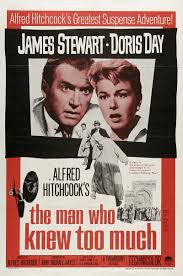

I always considered 1956 to be far superior, but I now realize that a lot of my problems with 1934 stem from seeing it on poor quality copies almost every time I watched it. Having recently seen a good copy of 1934, I've come to realize that I like both quite a bit. I still prefer 1956, but not by nearly as much as I had previously thought.
Between the two films, the basic story is the same but the way they are executed is enough different that watching one does not ruin your enjoyment of the other. Probably, the biggest difference is the ending, 1934 ends with a running gun battle, whereas, 1956 ends with 127 verses of the song, "Que Sera Sera." Remind me again, why I like 1956 better. Oh right, Jame Stewart and Doris Day.
Admittedly, the above is a bit facetious, but both film have their strengths and few if any weaknesses:
Admittedly, the above is a bit facetious, but both film have their strengths and few if any weaknesses:
- 1934:
- The pacing is excellent. It's a roller coaster ride, and even if there are parts that might seem a little hard to swallow, by the time you could even think that, you're already onto the next scene.
- Peter Loree is a great actor, and he is kind of the prototypical Hitchcock villain, smart, refined, funny, and likable. If anything, he might be too likable, you kind of hate to see him go. 1956 doesn't really have a villian. Actually, it probably does, but I don't remember a thing about him. The couple that kidnap James Stewart and Doris Day's son are lower level, they take orders from someone, but I couldn't tell you who he was or anything about him.
- 1956:
- Though 1956 doesn't have the break-neck pace of 1934 and adds scenes not in the original version, I never feel that it drags at all. The scenes that are added, though goofy in some respects, are hilarious, so you let it slide. The scene in the taxidermist shop and the friends waiting in their hotel for like 10 hours are stupid but in a fun way. Even Doris Day singing "Que Sera Sera" for 20 minutes still works (okay, it wasn't that long).
- Doris Day and James Stewart. For Doris Day, this is the movie that convinced me that she could really act, not just sing and do comedy, and James Stewart, it just doesn't get better than that. In 1934, I don't feel the anguish of the parents. That's what 1956 is all about, well that and the comedy.
Both 1934 and 1956 are very good but for entirely different reasons. I think Hitchcock is being too hard on himself with the talented amateur comment. Admittedly, Alfred Hitchcock made some films that are not good. 1934 is not one of them. It holds up well among any of the better Hitchcock films. I do still like 1956 better but 1934 is very good.
Monday, June 26, 2017
Summer Movie Blogathon Hits the Beach
Posts from June 25
- Anybody Got a Match, Summer Movie Blogathon… The Parent Trap (1961)
- Blog of the Darned, Summer Movie Blogathon – Dogtown and Z Boys
- City Lights, SMB: In the Good Old Summertime (1949)
- Movie Rob:
- Movies Silently, Fatty and Mabel at the San Diego Exposition (1915) A Silent Film Review
- Phyllis Loves Classic Movies, Ride the Wild Surf (1964)
Posts from June 24
- Blog of the Darned, Summer Movie Blogathon – Pajama Party
- Demanded Critical Reviews:
- The Midnite Drive-In, Don't Be Afraid of No Ghosts
- Movie Rob, Summer Movie Blogathon – The Sandlot (1993)
- Realweegiemidget Reviews, (500) Days of Summer (2009)
- Silents and Talkies, Summer Movie Blogathon: La Piscine (1969)
- The Stop Button, Indian Summer (1993, Mike Binder)
- Thoughts All Sorts, Summer Splashes ... The Way Way Back
Posts before June 24
- Cinematic Scribblings, Family Affair: The End of Summer (1961)
- Double Exposures, Bouquets of Faces: Christmas in July (1940, Dir. Preston Sturges)
- Film Perspective, Summer Movie Blogathon: Raiders of the Lost Ark
- Soul Ride, Summer Movie Blogathon: “Muscle Beach Party”
#####
We've been a little generous with our definition of Summer as indicated below. The only rule is no repeats on movies titles, first come first served. If interested, post a comment saying what movie you want to do below. Examples of qualifying films include the following.
Movies with Summer in the title:

Examples:
Movies about the beach, surfing, or summer sports:
 Examples:
Movies about summer or hot weather:

Examples:
Movies about vacation/camping or set in amusement park/resort area:

Examples:
Summer blockbusters (to qualify, must have been released between April and September):

Examples:
Here's what we have so far:
500 Hundred Days of Summer[Taken]- The Endless Summer
- Suddenly Last Summer
- Long Hot Summer
In the Good Old Summertime[Taken]Indian Summer[Taken]Summer of '42[Taken]- Summer of Sam
- Corvette Summer, they can't all be Casablanca, folks
Movies about the beach, surfing, or summer sports:

- Beach Party,
Muscle Beach Party, [Muscle Beach Party is Taken] ... - Gidget
- Ride the Wild Surf
Dog Town and Z Boys[Taken, unless someone else wants it real bad]- Deliverance
- Without a Paddle
- Major League
- Bull Durham
Movies about summer or hot weather:

Examples:
- Stand by Me
- Grease
- Dazed and Confused
American Graffiti[Taken]- Seven Year Itch
- Weekend at Bernie's
Movies about vacation/camping or set in amusement park/resort area:

Examples:
- Coney Island
- Roman Holiday
[Taken]Change of plans, Roman Holiday now open - National Lampoon's Vacation
- Meatballs
- Tucker and Dale vs. Evil
- Mr. Hobbs Takes a Vacation
- Euro-Trip
- Woman on the Run
Summer blockbusters (to qualify, must have been released between April and September):

Examples:
- Jaws
- Men in Black
Independence Day[Taken]Raiders of the Lost Ark[Taken]Ghostbusters[Ghostbusters and Ghostbusters II are Taken]
Here's what we have so far:
- 500 Days of Summer (2009), Realweegiemidget Reviews
- A Brighter Summer Day (1991), Charlene's (Mostly) Classic Movie Reviews
- Christmas in July (1940), Double Exposures
- Clash by Night, In the Good Old Days of Classic Hollywood
- ,The End of Summer (1961), Cinematic Scribblings
- E.T. the Extra-Terrestrial (1982) and American Graffiti (1973) demandedcriticalreviews
- Fatty and Mabel at the San Diego Exposition (1915), Movies Silently
- Ghostbusters (1984) and Ghostbusters II (1989), The Midnite Drive-in
- In the Good Old Summertime (1949), City Lights
- In the Heat of the Night (1967), Iron Clad Words
- Indian Summer (1993), The Stop Button
- Independence Day (1996), Listening to Film
- La Piscine (1969), Silents and Talkies
- Muscle Beach Party (1964), Soulride
- Pajama Party (1964) and if I get ambitious, I might do Dogtown and Z Boys (2001) as well (unless someone else wants it), Blog of the Darned
- The Parent Trap (1961), Anybody Got a Match
- Raiders of the Lost Ark, Film Perspective
Roman Holiday, In the Good Old Days of Classic Hollywood- Summer of '42, The Sandlot, and Little Darlings, Movierob
- The Way Way Back (2013) Thoughts All Sorts
Subscribe to:
Posts (Atom)