Monday, February 15, 2016

TCMFF Sidetrips, No. 1 – Ameoba Music

Updates to this post in Red text.

Have a little extra time to kill in Hollywood at the TCM Classic Film Festival (TCMFF), this series will cover a handful of my favorite destinations. 
Destination
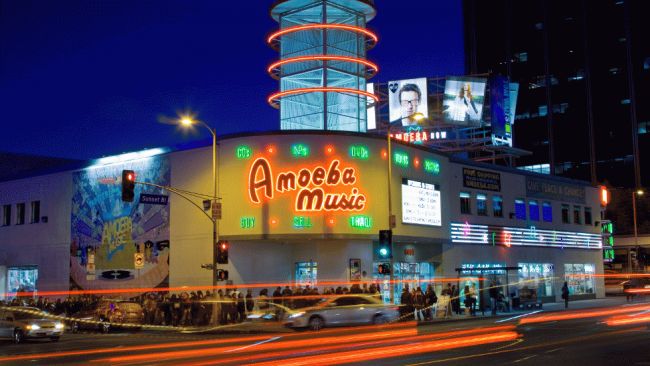
Amoeba Music
6400 Sunset Blvd. Los Angeles, CA 90028
Mon–Sat 10:30 am–11 pm, Sun 11 am–10 pm
(323) 245-6400

Getting there from the Festival

Located on Sunset Blvd., roughly two blocks south of Hollywood Blvd. and about 12 blocks east. Blocks are a little weird in Hollywood; your mileage may vary. Amoeba Music takes up the entire block on the south side of Sunset Blvd., between N. Cahuenga Blvd. and Ivar Ave.

Walking (about 15 to 20 minute walk from The Roosevelt)

Directions: Take one of the larger north–south streets south to Sunset Blvd. (suggest taking either North Orange Dr. or Highland Ave.). Go east on Sunset Blvd. to North Cahuenga Blvd.

Tip: If you like looking at sidewalk stars, take Hollywood Blvd. east to North Cahuenga Blvd., then south to Sunset Blvd., and you're there. After initially posting this, I stumbled on a site that covers a lot of Hollywood movie locations (links below). Going down this street, the 1600 block of North Cahuenga between Hollywood Blvd. and Selma Ave. is one of the streets Buster Keaton went down in The Cameraman:

Buster Keaton at 1612 North Cahuenga Blvd. (details below)
Metro/walking (in case you're too tired to walk)

Directions: Take the L.A. Metro from Hollywood/Highland station to Hollywood/Vine station (first stop going toward Union Station). From Hollywood/Vine station, take Hollywood Blvd. one block west to Ivar Ave. Take Ivar Ave. two blocks south to Sunset.

For me, no trip to Hollywood is complete without a trip to Amoeba Records. According to their web site, this is the world's largest independent music store. I'm inclined to believe it. This is what a really good music store used to be like back in the day, back when they had music stores. Looking for that rare out of print CD, they might have it at a decent price. How about an entire room devoted to Jazz, Blues, and Classical.

Movies more your thing? Upstairs is a loft dedicated to DVDs and Blu-Rays. Compared to the ground floor, it may seem small, but it's very well organized, and the selection of older movies is great. If you're used to video stores that are broken into Drama, Action, Comedy, Family, and so on, you'll be happy to find genres a little more geared to a classic film fan's tastes with separate sections for genres, such as Film Noir, Silent, and Pre-Code and sections devoted to directors like Alfred Hitchcock and Billy Wilder.

On top of all of this, if you already have too much stuff in your bag, and you don't want to carry it back, they will ship from the store for you.

Also in the area

At 1851 N. Ivar Ave. (two blocks north of Hollywood Blvd. and one block east of the Hollywood/Vine Metro Station) is the Alto-Nido Apartments. This is the location of William Holden's apartment building in Sunset Blvd.

Joe Gillis' apartment building from Sunset Blvd.
Thanks to Robby Cress at Dear Old Hollywood. Posts on Buster Keaton and Sunset Blvd. locations are:


Saturday, February 13, 2016

You Must Remember This…A Kiss Is Just a Kiss Blogathon – Bugs and Elmer

This post is part of the You Must Remember This…A Kiss Is Just a Kiss blogathon, hosted by Second Sight Cinema.


I think Leslie at Second Sight Cinema posted the Bugs and Elmer graphic above as a joke. Since I was kind of late getting on board, and I love old cartoons, it seemed like a natural for me.

Between the 1930s and 1960s, Warner Brothers produced several hundred cartoons under the Merry Melodies and Looney Tunes imprints. The most popular character of course is Bugs Bunny. According to Wikipedia, Bugs appeared in more films than any other cartoon character. While he often starred with Elmer Fudd, he also starred with Daffy Duck and Yosemite Sam in numerous films. In addition, Bugs made quite a few films, with one-off characters, like a boxer, a baseball player, and a circus lion. He starred with a mad scientist twice, including one played by a Peter Lorre parody.

My best friend has a theory that Bugs Bunny was the first gay cartoon character, and I think you can make a good case for it. Think about it, every chance he got, Bugs dressed in drag. When it came time to kiss someone, did Bugs kiss his trophy wife, Honey Bunny? No, he kissed Elmer, Yosemite Sam, or some other dude. 


Bugs and Elmer's first kiss from "A Wild Hare" ain't love grand
When you think of Bugs and Elmer, you think kissing. But I watched about 25 or 30 Bugs and Elmer cartoons, and less than half had them kiss. Often they were in kissing situations, but didn't actually kiss. Probably their most famous cartoon, "What's Opera Doc," where Bugs dresses in drag as a Valkyrie warrior, they do not kiss or even come close to it. One of the advantages of watching all of this is that I stumbled onto a lot of great old Hollywood stuff. For example, "Slick Hare," starring Bugs and Elmer features numerous star appearances, including Humphrey Bogart, Lauren Bacall, and great gag with Ray Milland paying his bar tab with a typewriter and getting change in little tiny typewriters. Again, no kissing.

As far this blogathon is concerned, I didn't think I could pull off a full post on a 7-minute cartoon. I decided the best approach would be to watch as many Bugs and Elmer cartoons as I could find. Then I covered all of the ones that had either kissing-like situations or actual kissing, a total of 15 cartoons. I broke these into Near Kisses and Kisses and ranked them from bottom to top. 

If you care, the rest of this post does contain SPOILERS.

Near Kisses

6. "Rabbit Romeo" (directed by Robert McKimson) – Elmer Fudd gets a delivery of a Slobovenian rabbit (Millicent) from his Uncle Judd Fudd. Millicent is heavy and being kind somewhat less than pretty. She talks like Natasha from Rocky and Bullwinkle and is desparate for a husband. Elmer catches Bugs Bunny and introduce him to Millicent. At one point, Bugs tricks her into kissing a goldfish instead of him. The goldfish promply commits suicide. Later Millicent kisses Bugs on both cheeks and Bugs goes to great effort to avoid kissing again. Admittedly Millicent is no prize, but since Bugs goes to such lengths to avoid kissing her, it kind of makes a case for the Bugs being gay argument. At the end of the cartoon, Bugs dresses Elmer up as a rabbit. It ends with Millicent chasing after Elmer, trying to kiss him. Seems like both Bugs and Elmer would rather be kissing each other if you ask me.


5. "The Big Snooze" (directed by Bob Clampett, uncredited) – Elmer Fudd frustrated with Bugs Bunny's abuse tears up his contract with Mr. Warner and swears off hunting to go fishing. Elmer falls asleep. Bugs takes sleeping pills so he can invade Elmer's dreams. The cartoon gets very surreal at this point. Through most of the dream sequence, Elmer is almost naked wearing a wreath of leaves on his naughty bits. Bugs puts Elmer in drag, and the animators make Elmer way sexy. Bugs changes the scene to Hollywood and Vine, where several wolves chase after Elmer. There's no kissing, but with the wolves chasing after sexy drag Elmer, I think this counts as a near kiss.

4. "Hare Remover" (directed by Frank Tashlin) – Elmer Fudd plays a scientist (Dr. Jeckyl parody) and tries to turn animals into devilish fiends. He tries it on his dog first, but it doesn't work. He then sets a rabbit trap for Bugs Bunny.  He gives Bugs the formula but nothing happens. Elmer breaks down crying, and Bugs makes a tonic to make him feel better. Through a misunderstanding, Bugs thinks that a bear is Elmer (changed by his tonic to a monster). Bugs kisses the bear thinking it's Elmer. Later through a similar misunderstanding, Elmer thinks that the same bear is Bugs (changed by his tonic). Elmer kisses the bear thinking it's Bugs. Technically, Bugs and Elmer do not kiss each other, but mentally and spiritually, oh yeah.

3. "Easter Yeggs" (directed by Robert McKimson) – The Easter Bunny cons Bugs Bunny into delivering his eggs for him. The first stop is Dead End Kid, a red headed juvenile delinquent, who nearly kills Bugs. The next stop is Elmer Fudd's house, where Elmer has laid a trap for the Easter Bunny.  Later, Elmer digs a pit and covers it up. When Bugs falls in, Elmer fills it with water. Bugs floats out in a life raft and into a hollow log. Elmer follows him in. On the other side of the log is a Tunnel of Love sign. Bugs and Elmer come out in a close embrace. There's no kissing shown but I'm thinking they were making out in that tunnel. 

2. "Bugs Bonnets" (directed by Chuck Jones) – The Narrator explains that costumes can influence behavior. Even a simple hunting cap on a mild-mannered character (Elmer Fudd) immediately turns him into a hunter out for rabbit (Bugs Bunny's) blood. To explore the phenomenon further, they have a truckload of assorted hats dropped into the woods. the rest of the cartoon is Bugs and Elmer switching hats and of course acting how the hats dictate. The key comes near the end of the cartoon, when Elmer dons a bridal veil and Bugs a top hat. The wedding march plays, and Bugs carries his bride (Elmer) to their honeymoon cottage. Bugs says, "... It always helps a picture to have a romantic ending. 


1. "Rabbit of Seville" (directed by Chuck Jones) – Elmer Fudd is hunting Bugs Bunny, when Bugs takes refuge in the Hollywood Bowl (presumably) during the opera. Bugs poses as a barber to abuse Elmer.  Bugs dresses in drag in green opera-ish outfit. Bugs is very much the vamp and embraces Elmer, but doesn't kiss him. Back to the barber routine, Bugs continues to mess with Elmer with various barber implements. Ultimately, Bugs offers Elmer flowers, candy, and then a ring and tricks Elmer into marrying him. Bugs carries bride Elmer up several flights of scaffoldings to their honeymoon cottage. Bugs opens the door, carries Elmer over the threshold, and drops him off into a Marriage of Figaro wedding cake.

Kisses

9. "Wideo Wabbit"  (directed by Robert McKimson) – Bugs Bunny is hired to be a guest on Elmer Fudd's hunting television show, The Sportsman's Hour. They put Bugs on ladder with an electric shocker, so that Bug will jump out of the hole on cue. Bugs runs off, and Elmer chases him through the studio. At one point, Bugs impersonates Groucho Marx, in a parody of Groucho's quiz show from the 1950s, You Bet Your Life. Elmer realizes that it is Bugs, not Groucho. Bugs takes off the mustache and glasses and kisses him. Later, Bugs does a parodies of both Liberace and Art Carney. You gotta love that.

8. "What's Up Doc" (directed by Robert McKimson) – Bugs Bunny is being interviewed by Dissociated Press. He explains his life story, how he was a rabbit born into a human world. As a child, he finds he has an affinity for music and goes into vaudeville. Ultimately, Bugs has trouble making the big in show biz. Down on his luck, he hangs out in park with other show biz has-beens, Al Jolson, Jack Benny, Eddie Cantor, and Bing Crosby. Elmer Fudd comes up, recognizes Bugs, and asks what he is doing hanging around with these bums. "They'll never amount to anything." Bugs joins Elmer's vaudeville act. At first, Bugs plays straight man to Elmer's corny jokes, until Bugs turns the tables on Elmer. On stage at gun point, Bugs stumbles on his catch phrase, "What's Up Doc" and they become a smash hit. Hollywood beacons. In a screen test, Bugs sings a "What's Up Doc" song and dances around a passive Elmer. Bugs does kiss Elmer, but as kisses go, it's nothing special. However, the cameos make this well worth watching.

7. "The Wacky Rabbit" (directed by Bob Clampett) – Elmer Fudd's character went through several incarnations. At first, he had the body we are used to, but with a head very similar to an earlier character named, Egghead. There was a brief period in the early 1940s, where they drew him much heavier. Here, fat Elmer is a prospector looking for gold in the desert. Bugs Bunny appears under a steer skull and spends most of the first part of the cartoon wearing it like a mask. Bugs tells Elmer that they have discovered gold. He shows Elmer the gold filling in his teeth. Elmer shows Bugs that he has one too. Bugs kisses Elmer and runs off and dives into his hole. While Elmer is trying to dig him out, Bugs takes some scissors and cuts off Elmer's shirt and suspenders, revealing that Elmer is wearing a dude corset. Bugs does a wolf whistle at Elmer's undergarments. You gotta love male fetishware. Elmer catches Bugs determined to get the gold tooth. He goes after Bugs. In the ensuing fight, Elmer removes his own tooth by mistake.

6. "The Old Gray Hare" (directed by Bob Clampett) – Here we see into the future, the year 2000. Elmer Fudd is old with a white mustache and hunts an old Bugs Bunny with a Buck Rogers ray guy. Bugs kisses him and hobbles off with his cane. Elmer shoots Bugs, and Bugs pretends to be dying. Bugs pulls out photo album with them as babies. They go into a flashback with baby Elmer hunting baby Bugs with a popgun. Baby Elmer crawls after baby Bugs, and they even take a nap in the middle of their chase. Eventually baby Elmer switches to a souped up baby buggie. Baby Bugs dresses as cop and pulls baby Elmer over on a pretend motorcycle. Baby Bugs kisses baby Elmer, making him cry. Back in the year 2000, Bugs continues to die, digging his own grave, but tricks Elmer into going into to it instead. Bugs buries Elmer, and Elmer says that at least Bugs is out of his life forever. Just then, Bugs digs his way into the grave, kisses Elmer, and hands him a stick of dynamite that goes off over the closing That's all Folks credits. Three kisses, two old and one as babies, the hell with Viagra.


5. "Wabbit Twouble" (directed by Bob Clampett) – Fat Elmer Fudd goes camping at Jellostone Park. Bugs Bunny puts up a sign that says, CAMP HERE. Elmer sets up camp, and the shenanigans are on. Bugs steals his tent and ties it into knots. Bugs puts dark glasses on Elmer while he's napping to make him think it's night already, then wakes him up in a minute later making him think it's morning. Elmer gets a gun to go after Bugs, but instead runs into a bear. Reading his camping book, Elmer plays dead to be safe from the bear. When the bear leaves, Bugs snarls and growls over Elmer, who still has his eyes closed. Bugs kisses Elmer, and Elmer gets a huge smile and blushes bright red. Very cute.

4. "Rabbit Fire" (directed by Chuck Jones) – Daffy Duck wears rabbit shoes to lead Elmer Fudd to Bugs Bunny's hole. There's a great verbal gag between Bugs and Daffy, "Wabbit season," "Duck season." Ultimately, Daffy dresses as a hunting dog, and Bugs dresses in drag as a woman hunter nearly shooting Elmer. Drag Bugs apologizes and kisses Elmer to make up. Elmer turns bright red, very much smitten.

3. "Hare-Brained Hypnotist" (directed by Friz Freleng) – Elmer Fudd learns hypnotism to control dumb animals of the forest. He hypnotizes a bear to make it think it's a canary bird. He tries to hypnotize Bugs Bunny, but it doesn't take, and Bugs kisses Elmer on the forehead. Things go awry when Bugs Bunny tries to teach Elmer a lesson by hypnotizing him and convincing him he's a rabbit. From there, it's a complete roll reversal, rabbit Elmer spends the rest of the cartoon messing with Bugs, including kissing him three times.

2. "A Wild Hare" (Directed by Tex Avery) – This is regarded as the first real Bug Bunny cartoon. Earlier films featured a cartoon rabbit that shared many features as Bugs, but this is where it all came together. Elmer Fudd is hunting wabbits. He find Bugs' hole and tries to lure him out with a carrot. While he is trying to get at Bugs. Bugs come out of a different hole and starts talking to Elmer who doesn't recognize him as a rabbit. Bugs come up behind Elmer puts his hands over his eyes and says, "Guess who?" Elmer guesses several actresses, Hedy Lamarr, Carole Lombard, and so on. Eventually Elmer realizes that it might be the rabbit. Bugs says, "Ummm, could be." He gives Elmer a big kiss and jumps in his hole. Elmer sticks his head down the hole, and Bugs gives him another  big kiss. Elmer sets a trap, but when he pulls out his quarry, it is a skunk. Elmer continues to talk to Bugs, bragging about how he caught him while holding the skunk. Bugs kisses him again. This is more or less the quintessential Bugs Bunny Elmer Fudd kissing cartoon. It has many of the gags that they would come back to over and over again when depicting Bugs and Elmer. As kisses go, not the greatest, but it set the standard.


1. "Rabbit Seasoning" (directed by Chuck Jones) – The cartoon opens with a play on Burma Shave advertising signs, indicating that it's Rabbit Season. As we move into to the woods we see more and more signs for Rabbit Season, including ones that lead Elmer Fudd right to Bugs Bunny's hole. Daffy Duck has put them up (it's really Duck Season). This has probably the best of the Bugs/Daffy verbal gags, pronoun trouble. The kiss comes toward the end. Bugs dresses in drag in a tight pink sweater and blond wig. Daffy asks whether Bugs has anything to say, "... out of sheer honestly." Bugs in a woman's voices says, "I would just love a duck dinner." Bugs kisses Elmer. Elmer's  eyes turn into stars, and he prances over to Daffy and shoots. Bugs, Daffy, and Elmer at their very best.

Thursday, February 11, 2016

Gold Diggers of 1933

Musicals don't get any better than Busby Berkeley, and if you ask me, Busby Berkeley doesn't get any better than his early work in the Pre-Code era. Berkeley created moving artwork with the human form and Gold Diggers of 1933 is one of his finest. He uses the female body in the same way a great painter uses canvas and oils.

The film has a great cast including Warren William, Joan Blondell, Ginger Rogers, Ruby Keeler, Dick Powell, Guy Kibbee, and Ned Sparks, as well as cool uncredited rolls for Sterling Holloway and Charles Lane. It's a formulaic plot but clever dialogue and great delivery by all the principals help it rise above.To be honest how much plot do you need in a musical anyway. 

The musical numbers are simply spectacular. Gold Diggers of 1933 opens with Ginger Rogers singing "We're in the Money" with both costumes and giant set pieces made of silver dollars. She even sings a verse in Pig Latin. How cool is that? The musical numbers shine throughout. Dick Powell sings two songs solo, "Shadow Waltz" and "I’ve Got to Sing a Torch Song."  "Shadow Waltz" appears later as a production number.

The "Pettin’ in the Park" number is is a fun and even by today's standards a little bit dirty. The silhouette scenes would never have made it just a little over a year after the film was released. The Hays code expressly forbid that sort of thing. "The Shadow Waltz" number with neon lighted violins and reflections of the dancers using both water from a pond on stage and the black lacquer floor is a masterpiece.

Gold Diggers of 1933 climaxes with "Remember My Forgotten Man."  With sets reminiscent of German expressionist film, the number portrays the plight of the ordinary man during the Depression. The marching beat and military theme make it seem instantly patriotic, but the lyrics about how society failed to support its own undercut that. It goes someplace you'd never expected in a film like this.


Finally, any film with a young Joan Blondell is worth watching for me. She is absolutely gorgeous. I often joke that if I had a time machine, I wouldn't go back and kill Hitler. I'd go back and try to seduce young Joan Blondell. The way she twists William Warren around her finger is awesome.

Pre-Code films were free to show things in a way that a short time later, censors would never allow. They also pushed the envelope with both racy dialog and subject matter. Gold Diggers of 1933 takes advantage in the most wonderful way.

Monday, February 8, 2016

µ-Blog – Really Short

µ-Blog – Too long to tweet, too short to call a real post

I was in a shopping mall the other day, a rarity for me. If you don't count going to see a movie, I can't even guess at the last time I was in a mall. As I was walking along, I saw a young woman late teens/early twenties with a couple in their forties, presumably her parents. I caught just a snip of their conversation.

Young woman: Yeah, he works out at the gym, like four and a half hours a day.

[Both of the parents got a slightly odd look on their faces] 

Father: Four and a half hours a day?

Young woman: He's really short.

I tried to put my head around that answer. Why would being short have any bearing on how long he works out? Does he have trouble reaching the machines? Does he have to wait for all of the normal-size people to finish?

Friday, February 5, 2016

Pride and Prejudice and Zombies Review

The Bennett sisters
I have something of an odd relationship with Jane Austen. My wife is a huge fan of the film and TV adaptations of her novels, though I don't think she has read any of them. There was a period of several months where my wife watched the 1995 TV adaptation of Pride and Prejudice with Colin Firth as Mr. Darcey, every night as I was going to bed.  She played it over and over again night after night as I drifted in and out of sleep. 

My wife likes all of the adaptations of Austen's work, so I've seen all of them multiple times. The weird part is that I know mostly that 1995 Colin Firth TV version, but in weird disjointed half hour segments. As a result, all of the adaptations seem somewhat disjointed and have a dream-like quality for me and I have a lot of trouble keep one story straight from the next. So when I sat down to watch Pride and Prejudice and Zombies this morning, the first thing I asked myself was, is this the one with Mr. Darcey?  Fortunately, I got my answer fairly quickly. One of the first, lines of dialog in the film is, "Colonel Darcey."

I haven't read the novel, Pride and Prejudice and Zombies, though I have heard nothing but good things about it. I can't say whether it is a great adaptation or a hatchet job. I can only say that the movie really works. Having seen so many versions of Pride and Prejudice, Pride and Prejudice and Zombies seems to follow the story of the original work, just with the addition of a 19th Century zombie apocalypse. 


One the most haunting image in the film
For me, it worked on both levels, as a period movie and adaptation of Jane Austen, it was excellent. All or at least most of the social intrigue of the original is there. Then it also works as a zombie movie. The opening montage is sort of like a combination of a popup book and a magic lantern show, but it serves the purpose of giving enough information about the zombies, so you can jump right in and not feel lost.

I actually cried at the end when Mr. Darcey and... well, you know, or would know if you've ever seen or read it before. As a zombie movie, it's a lot of fun. It's two things that you could never imagine would go together but captures the spirit of both in the most incredible way.


Thursday, February 4, 2016

PowerPoint and Time Travel

If I had a time machine, I think would go back to about 1987, infiltrate Microsoft, and do my very best to prevent PowerPoint from being invented, in much the same way as the Terminator going back to prevent John Connor from being born. I think this would the world a much better place. 

To be honest, there is really nothing wrong with PowerPoint. If you have to train a group of people in a short amount of time and just want to cover the highlights, PowerPoint is the way to go. The problem is when you try to use it for something it is not intended, namely technical documentation. At my old company, we had thousands of technical documents in PowerPoint. 

The Subject Matter Experts (SMEs) assured us the customers liked it, but the truth of the matter is that the SMEs liked it. They liked to think in bullet points. What I discovered when I would sit in on customer training sessions with these PowerPoint decks was that much was lost in the translation. Often the SMEs would skip over certain slides and spend 10 minutes explaining the bullets on others. 

Looking at the material, we knew it was lacking and set out to get rid of PowerPoint or at least limit it to training sessions where someone would be going over the material in a classroom setting. If it wasn't intended for training, we would convert to them documents. Simple, right? Not if you care about your information. 

The simple approach to converting PowerPoint decks into documents is to take all of the section title slides and make those chapter headings. Then turn all of the slide titles into headings and all of the bullets into complete sentences and you're done, right? Well, yes. You will have something that looks like a real document. It will have chapters and section headings, and you can make a table of contents.

At a glance, it will look like a real document, but when you read it, it doesn't say very much. It has lots of little one-paragraph sections. If the section title slides were done well, at least. it's organized, but likely they weren't, and it's not. Well, what are you going to do? Hopefully, a whole lot better.

Your first and best option is to find your SME and have them give you the training like for a customer. Record it. Note any spots, where slides are skipped. Possibly these can be eliminated or at least severely edited. And those ten minutes that the SME spends on one slide, you now can transcribe and try to make sense of it. 

Of course, that may not be possible. SMEs are busy people. Besides, that's why they have technical writers, right? Well, yeah. That's why we make the big bucks. Whether or not, you have access to the SME, the real work is still ahead.

Save a copy of the original file, you might need to refer to it after you start. Avoid the temptation of turning all of the bullets into complete sentences. Some of them might really be bullets. Also don't make the section title slides in chapters just yet. It might send you down a bad road and make it harder to see the structure you're looking for. Your best bet is just read it as it is. Then read it again. You probably need to read it four or five times. Fortunately, with PowerPoint, it shouldn't take that long to read, even several times.

Eventually, the structure will emerge. You'll notice groups of slides that discuss the same topic. That's where your sections come from. Maybe you need to create new headings to encompass them. Those slide titles that at a glance look like headings will often turn into the topic sentences for paragraphs made out of bullets that fall under them. Now is the time to turn those bullets into sentences and figure out which ones really should still be bullets.

You might end up with a lot of sections and no chapters, but look at it again. Maybe the sections are just in the wrong order and moving them around will show you where the larger groupings should be. Maybe, looking at the original file and the section title slides will help. Keep going until you find chapters for your sections. What you end up with may not be perfect, but it will be way better than where you started. Going forward, you have something to build on.

And the time machine, well, it would probably make a lot more sense to bring back something of value that I could sell in 1987 and use the money to buy as much Microsoft stock as possible at 1987 prices. Then I could just retire and never have to worry about PowerPoint again. Maybe somewhere out there is a PowerPoint deck waiting to be turned into a something useful that will unlock the secrets of time travel. I can dream, can't I.

Wednesday, February 3, 2016

TCMFF Top 5

With yesterday's announcement from TCM, we now have a total of 13 films announced for the 2016 TCM Classic Film Festival (TCMFF), April 28-May 1 in Hollywood. At this point, I thought I should do my top 5 picks of what's been announced so far. I did this last year as well, but kept revising it as more and more films were announced. I promise I won't be as bad this year.

No. 5. The King and I (1956). Me, I'm not a musical fan. That said, there are about a dozen of them that I really love. The King and I falls pretty high on that list.

No. 4. Horse Feathers (1932). The Marx Brothers on the big screen at TCMFF. Do I need to say more?

No. 3. Trapeze (1956). It seem like one time every year at TCMFF, there is one screening I go to because of the celebrity announcing it. Trapeze with Gina Lollobrigida introducing the film, that will probably be it. Maybe, I just have a thing for hot Italian, women.... In their 80s. You have no right to judge me.

No. 2. The Kid (1921). I love Charlie Chaplin, and a new restoration of The Kid, that's gotta be a must see. At least, until the full schedule drops and all of this speculation goes out the window.

No. 1. The Endless Summer (1966). If you were only to see one movie about surfing your whole life, Bruce Brown's The Endless Summer should be it. Getting to see it on the big screen with Bruce Brown introducing is gonna be a treat. Brown's low key narration provides humor and turns this from a great collection of surf footage into an adventure story about a couple of young surfers sharing their love of surfing with the world. Brown said that early on, everyone told him that the film would never play 50 miles from the ocean. To prove them wrong, he took the film to Witchita, Kansas, where lined up in the snow and sold out shows for weeks.